 Eastbound Finds
Looking for a sushi making class in Japan that runs in English? Hana’s short answer: there are plenty, from a 90-minute session in Asakusa to a morning that starts with a walk through Tsukiji Outer Market, and most can be booked online with free cancellation up to 48 hours before. Below are seven classes we checked on 16 October 2026 – in Tokyo, Kyoto, Osaka and Nagoya – followed by how sushi is actually eaten in Japan and which toppings are raw.
Key points
- Sushi making classes in Japan are bookable online in English; the seven we checked on 16 October 2026 cost US$55 to US$156 or ¥15,000 per person and last 1.5 to 3 hours.
- For a market visit, ABC Cooking's Tsukiji Outer Market tour with a sushi roll lesson costs ¥15,000, lasts about 3 hours and is for ages 10 and up (at least 130 cm tall).
- In Japan you may eat sushi with your hands or with chopsticks; both are normal, according to Japan's national tourism organization (JNTO).
Show more
- Dip the fish side, not the rice, in soy sauce, and do not stir wasabi into the soy sauce dish.
- Vinegar, soy sauce and wasabi do not kill anisakis parasites, so vinegar-cured mackerel still counts as raw fish.
Sushi making classes in Japan: seven compared
Prices are per person as shown on each listing on 16 October 2026 (Cookly shows US dollars; ABC Cooking shows yen). Your card converts at your bank’s rate.
AdvertisingQuick pick: Sushi making kits – Amazon.com
 Mikan's note: Before you pay for a sushi class, write any allergy or diet (vegetarian, halal) in the booking and wait for a reply; the Cookly classes here can be cancelled free only until 48 hours before the start, and the Tsukiji tour page states no cancellation rule, so ask first.
The “Language” column shows how easy it is to join without speaking Japanese: ◎ = booking and teaching in English, ○ = Japanese only, but you can book online and follow with a translation app, △ = hard with a translation app alone.
| Class | Where | Length | Price | What you make | Diet | Language |
|---|---|---|---|---|---|---|
| Tsukiji Fish Market Tour + Sushi Roll Making Lesson (ABC Cooking) | Tokyo – meet at Tsukiji Honganji, walk the Outer Market, then a cooking studio | about 3 h | ¥15,000 | rolls, temari sushi, tamagoyaki, miso soup | allergies and restrictions “upon request”; ages 10+ and 130 cm+; minimum 2 people | ◎ English |
| Tokyo Sushi-making, Sake Ceremony & Whisk Matcha | Tokyo – Asakusa, 1–2 min from Tobu Asakusa Station | 1.5 h | US$73 | 6–12 pieces of maki and nigiri, gunkan with salmon roe, matcha | vegan/vegetarian on request; non-alcohol option for the sake | ◎ English, Japanese |
| Edomae Sushi Masterclass | Tokyo – meet at Sasazuka (Keio Line, one stop from Shinjuku) or Shimokitazawa | 2.5 h | US$105 | inari, gunkan, maki, nigiri | vegetarian option | ◎ English, Japanese |
| Nigiri Sushi Making for Everyone | Tokyo – near Asakusa | 2.5 h | US$156 | nigiri, gunkan-maki, miso soup | separate vegetarian class (adds inari and rolls) | ◎ English |
| Makizushi Rolls Making Class | Kameoka, Kyoto Prefecture (meet at JR Kameoka Station) | 2.5 h | US$93; children 6–12 US$47 | sushi rolls, miso soup, sweets | not stated – ask | ◎ English, Japanese |
| Let’s Make Artistic Sushi in Osaka | Osaka – near Nakazakichō Station | 2 h | US$55 | one decorative roll (e.g. cherry blossom or panda) | not vegetarian; not for fish allergies | ◎ English, Japanese |
| Cute and Colorful Temari Sushi | Nagoya – 5 min from Shin-sakae-machi or Kakuozan Station | 2.5 h | US$111 | temari sushi, dashi and clear soup, two sides, tofu pudding | not stated – ask | ◎ English, Japanese |
| Local classes on Japanese-only booking sites | various | – | – | – | – | ○ booking form in Japanese |
| Classes booked by phone only or through an introduction | various | – | – | – | – | △ see below |
The six Cookly classes give a full refund for cancellations at least 48 hours before the start. The ABC Cooking page does not state a cancellation rule, so check it in the booking system before you pay. Prices change; check the listing on the day you book.
Which class fits your trip?
- You want to see a fish market first: the Tsukiji tour. Note that it visits Tsukiji Outer Market, the shopping streets that stayed in Tsukiji, not the wholesale market that moved to Toyosu. Children under 10 cannot join.
- You have only a morning or an evening: the 90-minute Asakusa class has five start times a day (10am to 6pm). It includes a sake-barrel ceremony; ask for the non-alcohol option if you don’t drink.
- You want to learn real nigiri technique: the Edomae masterclass in Sasazuka or the Asakusa nigiri class. The second costs more but has a separate vegetarian version.
- You are travelling with children: the Kyoto roll class lists a child price for ages 6–12. The Osaka class costs the least of the seven and focuses on a picture roll that children tend to enjoy.
- You are not in Tokyo, Kyoto or Osaka: the Nagoya temari class is near the city centre and adds dashi and side dishes, so it teaches more of a Japanese meal than sushi alone.
- A class is not for you if you mainly want to taste top-level sushi. A counter restaurant is a better use of the money; a class teaches how sushi works rather than serving a chef’s best pieces.
Diet: if you are vegetarian, halal or have allergies, write it in the booking and wait for an answer before paying. Sushi rice is seasoned with vinegar, sugar and salt, but sauces and side dishes may contain mirin, dashi (fish stock) or other ingredients.
When a class is hard to join without Japanese (△)
Some small or traditional classes take bookings only by phone, accept guests through an introduction, or give a detailed knife and hygiene briefing in Japanese. A translation app alone is usually not enough there. Ways in: ask your hotel or ryokan to call for you, book a food tour with an English-speaking guide, or choose a class that lists English as the class language.
For other hands-on activities – tea ceremony, wagashi, pottery – see our guide to cultural experiences in Japan.
What makes sushi in Japan different from sushi abroad?
Japan’s agriculture ministry (MAFF) traces nigiri to Edo, today’s Tokyo, and describes classic Edo-mae sushi as rice seasoned with red vinegar (akazu), topped with fish that has been worked on before it reaches you: kohada and mackerel cured in vinegar, conger eel simmered and brushed with sweet sauce, shrimp steamed, tuna marinated in soy (zuke), white fish cured in kelp. That is why a Tokyo sushi chef talks about “preparing” toppings, and why a plain-looking piece can taste of more than raw fish.
At the other end, conveyor-belt sushi is cheap and everyday. Kura Sushi’s official menu, for example, sorts its shops into price tiers where plates start at ¥110, ¥115, ¥125 or ¥145, and notes that prices differ at some shops (checked 16 October 2026). Many chains take orders on a touch panel at your seat. Rolls with cream cheese and sauces, familiar from sushi bars abroad, are not the centre of a typical Japanese menu, which is built around nigiri.
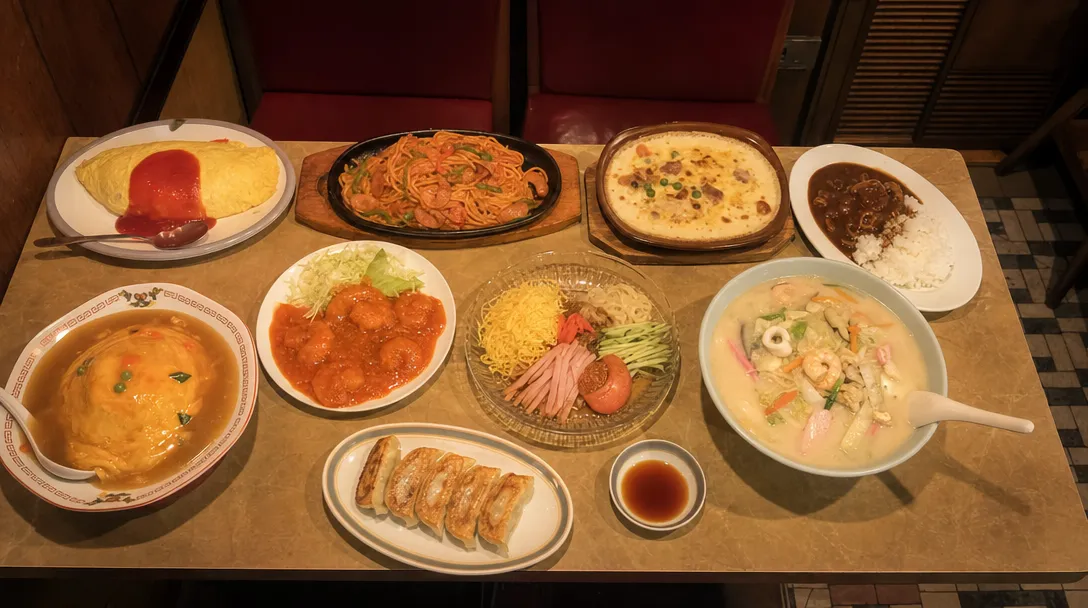 Related guidesYoshoku meaning: omurice, napolitan and Japan's own 'Chinese' food
Hands or chopsticks: which is correct?
Both. Japan’s national tourism organization (JNTO) writes that sushi in Japan is generally eaten with chopsticks or with your hands. At a sushi counter, you are often given an oshibori (wet towel) before the meal; use it for your fingers, not your face.
A few habits matter more than the hands-or-chopsticks question:
- Soy sauce on the fish, not the rice. JNTO says the rice should not be dipped directly in soy sauce, only the fish on top. Tip the piece on its side, pick it up, and touch the topping to the sauce.
- Wasabi stays out of the soy sauce dish. JNTO also says not to mix wasabi directly into soy sauce. At a counter, the chef usually puts a little wasabi between the fish and rice already.
- One piece, one bite where possible. Nigiri is shaped to be eaten whole; biting it in half often breaks the rice.
- Gari (pickled ginger) is eaten between pieces, not piled on top of the sushi.
- Don’t leave food. JNTO notes that leaving leftovers is frowned upon, so order a few pieces at a time.
JNTO adds that these rules are taken more seriously at high-end sushi restaurants, while conveyor-belt sushi (kaitenzushi) and chains are more relaxed. Before eating, people say itadakimasu; after, gochisōsama deshita.
The sushi styles you will meet
| Style | What it is | Where you see it |
|---|---|---|
| Nigiri | hand-pressed rice with a slice of fish or another topping | counters, conveyor-belt shops, classes |
| Gunkan-maki | a ring of nori around rice, filled with loose toppings such as salmon roe or sea urchin | conveyor-belt shops, classes |
| Hosomaki | a thin roll with one filling, e.g. cucumber (kappa maki) or tuna (tekka maki) | everywhere |
| Futomaki / makizushi | a thick roll with several fillings, often cooked or vegetable | supermarkets, home cooking, classes |
| Temari | small round balls of rice with a topping | home parties, classes |
| Temaki | a hand-rolled cone of nori you eat right away | home parties, some restaurants |
| Chirashi | toppings scattered over a bowl of sushi rice | lunch sets, home cooking |
| Inari | sushi rice inside a sweet simmered tofu pouch | supermarkets, vegetarian menus |
Which toppings are raw and which are cooked?
This matters if you are pregnant, travelling with children, or simply not sure about raw fish.
| Topping (Japanese name) | Usually | Note |
|---|---|---|
| Maguro (tuna): akami, chūtoro, ōtoro | raw | lean to fatty cuts of the same fish |
| Sāmon (salmon) | raw | a common topping in Japan today |
| Hamachi / buri (yellowtail), tai (sea bream) | raw | |
| Saba (mackerel), kohada (gizzard shad) | cured in salt and vinegar | still raw fish – see the safety section |
| Ika (squid) | raw | |
| Tako (octopus) | boiled | |
| Ebi (shrimp) | boiled; amaebi (sweet shrimp) is raw | ask which one you are getting |
| Anago (conger eel) | simmered, brushed with sweet sauce | |
| Ikura (salmon roe), uni (sea urchin) | raw | served as gunkan-maki |
| Tamago (tamagoyaki) | cooked omelette | |
| Kappa maki, kanpyō maki, inari | no fish | kanpyō is simmered gourd strips |
Is raw fish in Japan safe?
Sushi in Japan is generally handled with care, but two official notes are worth knowing.
Anisakis. Japan’s health ministry (MHLW) lists fish such as mackerel, horse mackerel, bonito, sardine, salmon, flounder, tuna and squid as carriers of anisakis larvae. It states that ordinary vinegar, salting, soy sauce and wasabi do not kill the larvae. For businesses it recommends freezing at −20 °C for 24 hours or more, or heating to 70 °C or above, plus visual checks. Symptoms – sharp stomach pain, nausea, vomiting – appear from a few hours to several days after eating (stomach symptoms usually within 12 hours); see a doctor if this happens.
Pregnancy. MHLW asks pregnant women to limit fish higher in mercury, not to avoid fish. Bluefin tuna (kuro-maguro), bigeye tuna (mebachi), splendid alfonsino (kinmedai) and swordfish are limited to about 80 g once a week; the same notice puts one piece of sushi at about 15 g, so that is roughly five pieces. Yellowfin, albacore and young bluefin (mejimaguro) are fine in normal amounts. Separately, MAFF advises pregnant women to cook seafood thoroughly and to avoid ready-to-eat foods such as smoked salmon because of listeria. Advice differs between countries, so follow your own doctor; cooked toppings and vegetable rolls from the table above are easy alternatives.
Making sushi at home after your trip
If the class made you want to try at home, the two things that matter most are the rice and a sharp blade. Our Japanese rice cooker guide explains how to choose a cooker that handles short-grain Japanese rice, and the Japanese knives guide covers the yanagiba, the long knife used for slicing fish. For something to drink alongside, see how to choose matcha.