 Eastbound Finds
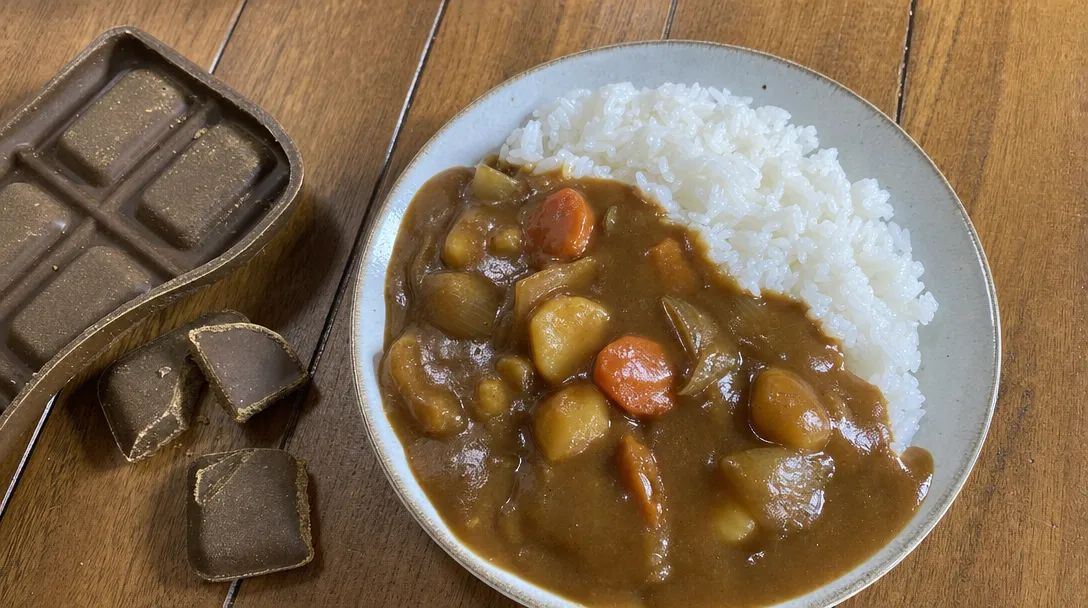
Hana here. Japanese curry roux is a solid block, a bit like a chocolate bar, that you break into a pot of simmered vegetables and meat to make a thick, glossy curry sauce for rice. This guide compares the bricks you are most likely to find (S&B Golden Curry, House Vermont Curry and House Java Curry), shows what the official ingredient lists say about meat extract, dairy and wheat, lists the curry dishes Japan has built on the same sauce (from curry bread to Sapporo soup curry), and explains why the box from a Japanese supermarket is not always the one to bring home.
Key points
- Japanese curry is a thick, mild stew served over rice, and most homes make it from solid roux blocks rather than from spices.
- Golden Curry (S&B) lists palm and rapeseed oil and no meat extract or milk in its Japanese version, while Vermont and Java (House) contain pork extract and a beef and pork fat blend.
- Japan has built many dishes on curry beyond curry rice, including katsu curry, curry udon, deep-fried curry bread, retort-pouch curry, Sapporo soup curry and Yokosuka Navy Curry.
Show more
- US Customs says bouillon and soup mixes containing meat are not allowed in, so do not pack Vermont or Java bought in Japan; the US-market Golden Curry says it has no meat-derived ingredients.
- Cook the vegetables and meat first, take the pot off the heat, stir in the roux, then simmer on low for about 10 minutes.
Why Japanese curry is not Indian curry
Curry reached Japan in the early Meiji period (from the 1870s) by way of Britain, which ruled India at the time, according to Japan’s Statistics Bureau. That route explains a lot: Japanese curry is closer to a British-style stew thickened with flour than to the spice-based curries of India. It is mild, sweet-savoury and thick enough to sit on rice, and it usually holds chunks of potato, carrot and onion.
AdvertisingQuick pick: S&B Golden Curry roux, mild, medium hot and hot (3 boxes) – Amazon.com
 Mikan's note: Vermont and Java sold in Japan contain pork extract and beef and pork fat, and US Customs does not allow meat-based soup mixes in, so buy the US-market box instead of packing one in your suitcase.
The roux block made it a weeknight dish. S&B made Japan’s first domestic curry powder in 1923, sold a solid “S&B Curry” in 1954 and launched Golden Curry in 1966, according to its company history. House Foods’ first solid roux was Indo Curry in 1960, followed by Vermont Curry in 1963. Today the shelf in any Japanese supermarket is a wall of these boxes, each in mild (amakuchi), medium hot (chūkara) and hot (karakuchi).
Types of Japanese curry dishes: rice is only the start
Curry rice is the base, but Japan has turned the same mild, thick sauce into a whole family of dishes, and most of them are not on an Indian menu. These are the ones a visitor is most likely to meet. The facts in the right-hand column are from official sources, checked on 1 November 2026.
| Dish | What it is | A fact worth knowing |
|---|---|---|
| Katsu curry | Curry sauce over rice with a breaded, deep-fried pork cutlet | The cutlet is usually pork, so it is one to skip if you avoid pork |
| Curry udon | Thick wheat noodles in a curry broth | The noodles are wheat, like every roux in the table further down |
| Curry bread (karē pan) | Curry filling wrapped in bread dough, usually coated in breadcrumbs and deep-fried | The Japan Curry Bread Association’s Curry Bread Grand Prix 2026 had 142 entries and 132,491 votes; the awards ceremony was held on 20 July 2026 |
| Retort-pouch curry | Ready-made curry in a pouch that you heat in hot water | Otsuka Foods says Bon Curry, first sold on 12 February 1968 in the Hanshin area and nationwide from May 1969, was the world’s first retort curry sold in shops |
| Soup curry (Sapporo) | A light, spiced broth with big cuts of vegetables and meat, eaten with rice on the side | Sapporo’s official tourism site says it was born in the city about 50 years ago and that there are over 200 specialty restaurants |
| Yokosuka Navy Curry | Curry based on a recipe in a Japanese Navy cookbook dated to 1908 | Yokosuka declared itself a “curry town” on 20 May 1999, and the rule is to serve Navy Curry with salad and milk |
| Curry chain restaurants | Curry rice with toppings, served fast | CoCo Ichibanya had 1,285 restaurants in Japan and 218 overseas at the end of February 2026 |
So when someone says Japanese curry, ask which one. A fried curry bread from a bakery and a bowl of Sapporo soup curry share a name and not much else. If you bring retort pouches home, read the meat ingredients first: the US customs rules in the section on boxes sold abroad apply to them too. If you would rather skip that worry, S&B’s overseas Curry Sauce with Vegetables (210 g, medium hot) lists potato, carrot and onion and says it contains no meat or meat-related ingredients; it heats in boiling water in 3 to 5 minutes.
 Related guidesRamen types explained: shoyu, shio, miso, tonkotsu and tsukemen
Golden Curry vs Vermont vs Java: what is inside
The ingredient lists below are from each maker’s Japanese product page, checked on 19 October 2026. Export versions can be different (see the next section).
| Roux (maker) | Fat in the roux | Meat extract | Dairy | Allergens listed in Japan | Heat levels |
|---|---|---|---|---|---|
| Golden Curry (S&B) | Palm and rapeseed oil | None listed | None listed | Wheat, soy, gelatin | Mild, medium hot, hot (plus an extra-hot “Bari-kara”) |
| Vermont Curry (House) | Beef tallow and lard blend, palm oil | Pork extract | Whole and skimmed milk powder | Milk, wheat, soy, chicken, banana, pork, apple | (see box) |
| Java Curry (House) | Beef tallow and lard blend, palm oil | Chicken and pork extract | Milk | Milk, wheat, sesame, soy, chicken, pork | (see box) |
| Torokeru Curry (S&B) | (see box) | Beef and chicken bouillon powder | (see box) | Wheat, beef, soy, chicken, pork | (see box) |
| Kokumaro Curry (House) | (see box) | (see box) | Butter added in the February 2026 recipe | (see box) | Mild, medium hot, hot, 145 g each |
What the table means in practice:
- Fruit in the roux: Vermont lists apple and banana among its allergens, which tells you fruit is part of its flavour.
- If you avoid pork, the Japanese Vermont and Java are out, and so is Torokeru. Golden Curry lists no meat extract, but gelatin is on its Japanese allergen list.
- None of them is gluten-free. All four lists that show allergens include wheat.
The box sold abroad is not the same box
S&B sells a separate overseas range. Its overseas Golden Curry pages say the roux contains no meat or meat-derived ingredients, and give the sizes as 92 g (about 5 servings) for Mild and 220 g (12 servings) for Medium Hot. The Japanese Golden Curry is a 198 g box split into two trays of 5–6 servings each. So a Golden Curry box in a US store and one in a Tokyo supermarket can carry different ingredient lists, even with the same name.
This matters most if you are thinking of bringing roux home from a trip:
- US Customs (CBP) lists bouillon and soup mixes that contain meat among items you cannot bring in.
- USDA APHIS says most meat products from countries affected by classical swine fever are not allowed. Japan has not had the disease-free status since 2018. APHIS also warns that meat extracts and bouillon sent by mail may not be allowed.
So a Vermont or Java box from a Japanese supermarket, with pork extract and lard in it, is the wrong souvenir for a US kitchen. The same goes for pork-bone flavour packets of instant noodles, as our guide to Japanese ramen types explains. The US-market Golden Curry, which states it has no meat-derived ingredients, is the easy choice.
How to cook it (House’s official method)
House’s English recipe for a 12-serving box of Vermont Curry:
- Sauté meat, onion, carrot and potato, then add 1,400 ml of water (1,250 ml if you cook with a lid) and simmer for about 15 minutes.
- Take the pot off the heat, break in the roux and stir until it melts.
- Put it back on low heat for about 10 minutes, stirring now and then, until it thickens.
Serve it over short-grain Japanese rice: if you cook a lot of rice at home, our guide to Japanese rice cookers helps you choose one.
Hayashi rice: the curry roux’s cousin
The same aisle sells hayashi roux, a sweet tomato and demi-glace sauce for beef and onion over rice. House sells Hayashi Rice Sauce with ripe tomatoes (92 g for 5 servings, 184 g for 10), and S&B sells Golden Hayashi Rice Sauce (193 g, two trays of 5–6 servings). It cooks the same way as curry roux and is a good pick for anyone who does not like spice at all. Hayashi rice is one of the classics of yoshoku, Japan’s own Western food, alongside omurice and napolitan.
Halal Japanese curry roux
Do not take “no meat” as “halal”. The only Japanese-maker curry roux we found with a halal mark on its official information is Sasa House KARI JEPANG, which House Foods Group launched in Indonesia in February 2024 through a joint venture. Its packs carry the halal mark of Indonesia’s government halal agency, BPJPH. Outside Indonesia, look for a halal certification mark on the box itself rather than relying on a seller’s description.
Your next step
- Decide on heat level and fat: Golden Curry if you want a roux without meat extract, Vermont or Java if pork and beef fat are fine for you.
- If you are in the US, buy the US-market box and read its ingredient list there; do not pack Japanese Vermont or Java to bring home.
- Try a box of hayashi roux too, and if your curry habit grows, the Japanese snack and food boxes we compared can bring other Japanese pantry items to your door.
Ingredient lists, sizes and the House recipe checked on the makers’ official pages on 19 October 2026; US Customs and USDA pages checked the same day. The curry dishes table was checked on 1 November 2026. Recipes and rules change, so read the box and the CBP page before you buy or travel.