 Eastbound Finds
Fushimi Inari Taisha has about 10,000 torii gates standing along the paths of its mountain, and the shrine itself compares its grounds – about 870,000 m², most of it Mount Inari – to roughly 22 Koshien baseball stadiums. That is the scale behind Kyoto’s most photographed walk. The short answer to “which Kyoto experiences should I book?”: a tea ceremony, a kimono rental and, if you want the story behind the gates, a guided walk at Fushimi Inari. Book those ahead, and plan around three Kyoto-specific things most guides skip: the accommodation tax that changed on 1 March 2026, a bus pass that lasts a calendar day rather than 24 hours, and the rules Gion residents ask visitors to follow. All facts checked 23 October 2026.
Key points
- The Kyoto experiences most worth booking ahead are a tea ceremony, a kimono rental and a guided walk at Fushimi Inari Taisha; Camellia (tea) and Waraku (kimono) take bookings on English websites.
- Since 1 March 2026 Kyoto's accommodation tax is 200 to 10,000 yen per person per night, depending on the room-only rate, and it may not be included in the booking-site price.
- The Subway & Bus 1-Day Pass costs 1,100 yen for adults and 550 yen for children and is valid only on the calendar day you first use it, not for 24 hours; JR and Keihan trains are not covered.
Show more
- In Gion, local residents ask visitors not to photograph geiko and maiko without permission, not to touch or follow them, and not to enter private property.
- JR Inari Station is 5 minutes from Kyoto Station and right outside Fushimi Inari Taisha; the Kyoto City Tourism Association publishes an hourly crowd forecast for the area.
Fushimi Inari, beyond the photo: torii, foxes and vermilion
A guided walk makes more sense once you know what you are looking at. From the shrine’s own pages:
AdvertisingQuick pick: Tea ceremonies in Kyoto – GetYourGuide
 Mikan's note: Wait! Kyoto's accommodation tax is charged per person per night and is not always in the booking-site price, so you may pay it at the front desk. Read each experience's cancellation rule on the booking page before you pay.
- “Senbon Torii” is not the whole count. The famous “thousand torii” is the name of one section. Across the mountain there are about 10,000 torii, and the custom of offering a torii as a gesture of thanks spread from the Edo period.
- The fox is not the deity. Foxes are regarded as messengers (kenzoku) of the kami – and, the shrine stresses, not the foxes you see in the hills but invisible beings. The kami of Inari is not a fox.
- The vermilion has a practical side. The colour is traditionally seen as warding off evil, and at Inari also as the colour of a rich harvest. The pigment is cinnabar, which contains mercury and has long been used to protect wood from rot.
- It is the head shrine of about 30,000. There are about 30,000 Inari shrines across Japan, and Fushimi Inari Taisha is the head shrine. Its kami was enshrined on the first Day of the Horse of the second month of 711.
Fushimi Inari is an active place of worship, not a theme park, so the usual shrine manners apply. Our guide to shrine and temple etiquette walks through the hand-washing and the bow-clap-bow step by step. If you want to collect a shrine stamp, read how goshuin are received first – it is part of a visit, not a souvenir counter.
Kyoto experiences compared: what to book and where
This table is about Kyoto only. For sushi, pottery, kintsugi and sumo across Japan, see our cultural experiences in Japan guide. With a spare half day, Hikone Castle – an original castle keep with a cat mascot – is about 46 minutes from Kyoto by JR Special Rapid.
The “Without Japanese” column: ◎ = booking and guidance in English (confirmed on the official site). “—” = not graded, because we could not confirm the language ourselves; check the listing. △ = hard with a translation app alone.
| Experience | Where in Kyoto | What the official site says (checked 23 Oct 2026) | Without Japanese |
|---|---|---|---|
| Tea ceremony – Camellia | Flower Teahouse in Higashiyama; Garden Teahouse near Ryōan-ji (Ukyō) | Shared session at Flower Teahouse from 4,000 yen per adult, 2,500 yen for ages 6–12; private from 8,000 yen; Garden Teahouse private from 15,000 yen | ◎ English site with online booking |
| Kimono rental – Waraku | Four shops: Gion, Kiyomizu-dera, Arashiyama, Kyoto Station | Kimono and yukata plans from 1,980 yen; return by the shop’s set time; same-day booking possible when there is space | ◎ English site, says it helps foreign visitors get dressed |
| Guided walk at Fushimi Inari | Fushimi, next to JR Inari Station | Booked through tour operators; check the meeting point and what is included | — check the guide language on the listing |
| Guided walk in Arashiyama | Western Kyoto | Booked through tour operators | — check the listing |
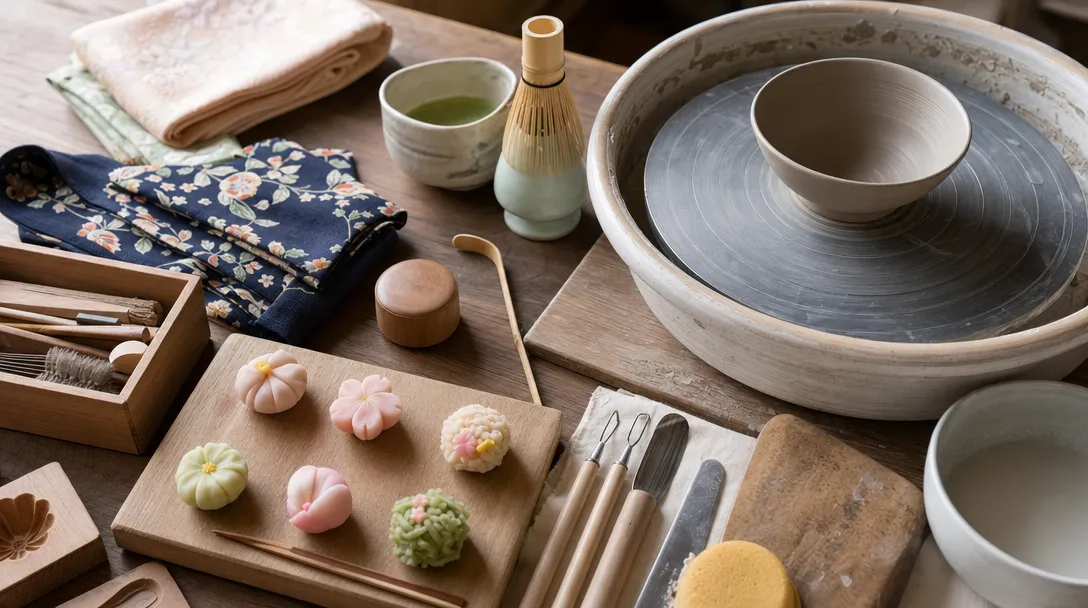
| Wagashi (Japanese sweets) making | Various | Run by independent schools | — check the listing |
| Classes booked by phone only | Various | – | △ see below |
Two practical links between the rows: Camellia offers a one-day kimono rental for an extra 6,000 yen, so you can do tea in kimono without a second booking – but not at the Garden Teahouse. And because Waraku has a shop in Arashiyama and one in Gion, you can start the day in kimono in the same area as your walk.
For the △ type – classes that take bookings by phone only, or need a detailed safety briefing in Japanese – ask your hotel or ryokan to call for you, or book a tour that includes an English-speaking guide or interpreter.
 Related guidesJapan Autumn Leaves Forecast 2026: Peak Dates for Kyoto, Tokyo and Nikko
Why do a tea ceremony in Kyoto? A short history
The tea you are served goes back to Sen no Rikyū (1522–1591), who was born into a merchant family in Sakai. In 1591 he was ordered by Toyotomi Hideyoshi to take his own life, and died at 70. According to Urasenke, Rikyū’s grandson Sōtan built the tea rooms Konnichian and Yūin at his retirement residence and passed them to his fourth son, Sensō Sōshitsu – the start of Urasenke. The line of his third son, Kōshin, became Omotesenke, and that of his second son, Ichiō, Mushakōjisenke. Together they are called the San-Senke, the three Sen houses – names you will see on tea-house signs and in class descriptions.
If the matcha makes you curious, our guide to choosing matcha explains grades and how to buy it.
Gion: what local residents ask visitors
Gion is a neighbourhood where people live and work, not only a sightseeing street. The Southern Gionmachi district council made a manners leaflet with Kyoto Women’s University, carrying the names of the Gion Kobu teahouse and geiko associations and Kennin-ji temple among others. It was shared by the Kyoto City Tourism Association in January 2024. It asks visitors:
- not to photograph geiko and maiko without permission, and not to touch, stop or follow them – “they are not mascot characters”;
- not to enter private property, including nearby temples, shrines and private land, without permission;
- not to stand in the street for photos or step into the road – the streets are not pedestrian-only;
- not to litter or speak loudly. Guides are asked to explain these rules to their groups beforehand.
The leaflet also notes that following someone, trespassing or blocking traffic can be subject to legal penalties. If you book a guided walk in Gion, that briefing should be part of it.
When is Fushimi Inari less crowded?
There is no official “quiet hour”, but there is an official tool. The Kyoto City Tourism Association’s sightseeing comfort forecast (観光快適度) shows an hourly forecast on a five-level scale of how busy the area around popular sights will be, and the Fushimi Inari area is covered. Change the date and time to find a calmer slot, then book your guided walk or kimono for that window. The shrine itself links to the forecast and asks visitors to come by public transport, because the roads around it get very congested.
Getting there: the 1-day pass and what it does not cover
- JR Inari Station is 5 minutes from Kyoto Station, and the shrine is right outside the station.
- Keihan Fushimi-Inari Station is about 5 minutes’ walk to the east.
- City bus route Minami 5 stops at Inari Taisha-mae, about 7 minutes’ walk east of the shrine.
The Subway & Bus 1-Day Pass costs 1,100 yen for adults and 550 yen for children. It covers both subway lines (Karasuma and Tōzai), all city bus routes and some Kyoto Bus, Keihan Bus and West JR Bus routes (not seasonal or express routes). The catch: it is only valid on the day you first use it, not for 24 hours – start it in the morning, not at 4 pm. You can buy it in advance at city bus and subway information offices and subway stations, on city buses (it can sell out) and at some convenience stores, tourist information centres and hotels. JR and Keihan trains are not covered, so the train to Inari is a separate fare.
How much is Kyoto’s accommodation tax in 2026?
Since 1 March 2026, the City of Kyoto charges this tax per person, per night, based on the room-only rate (room charge plus service charge; meals and consumption tax are not counted):
| Room-only rate per person per night | Tax per person per night |
|---|---|
| Under 6,000 yen | 200 yen |
| 6,000 to under 20,000 yen | 400 yen |
| 20,000 to under 50,000 yen | 1,000 yen |
| 50,000 to under 100,000 yen | 4,000 yen |
| 100,000 yen or more | 10,000 yen |
Example: two people sharing a room at 30,000 yen per person per night for three nights pay 1,000 × 2 × 3 = 6,000 yen in tax. The city says the tax may be included in what you pay a booking site or travel agency – but when it is not, the hotel collects it from you. When comparing Kyoto hotels, check whether “taxes” in the price includes this one, especially if your rate sits just above 20,000 or 50,000 yen.
Before you walk under the first torii
You have the bookings, the pass and the forecast. One question is left for the moment you reach the gate: do you walk through the middle, bow first, or wash your hands before anything else? Our shrine vs temple etiquette guide answers that – and explains why you clap at a shrine but not at a temple.