 Eastbound Finds
Saw someone with a book full of red seals at a Japanese temple? Those are goshuin. This guide explains what goshuin are, how to ask for one politely, what it costs and how to choose a goshuincho (goshuin book). In short: visit first, then go to the temple or shrine office, hand over your book, pay the fee (often a few hundred yen) and wait. This is a guide to culture and manners, not to religious belief. Checked on 10 October 2026; history, Tōdai-ji halls and payment tips added and checked on 19 October 2026; where to buy a goshuincho added and checked on 31 October 2026.
Key points
- A goshuin is a red seal with brush calligraphy that a temple or shrine gives you as a record of your visit; it is not a souvenir stamp you press yourself.
- Visit first, then ask for the goshuin at the temple or shrine office, usually in your own goshuin book (goshuincho).
- Fees are set by each temple or shrine; Tōdai-ji in Nara, for example, asks 300 yen per goshuin (checked 10 October 2026).
Show more
- You can usually get a goshuincho at the temple or shrine itself; Tōdai-ji sells them for 1,500 to 2,500 yen.
- Offices have set hours, often ending around 4–5 pm, so do not leave it to the end of the day.
What is a goshuin?
A goshuin is a red seal combined with brush calligraphy – usually the name of the temple or shrine, the main object of worship and the date – written by staff of the temple or shrine. It is a record that you visited, not a stamp you press yourself like the stamps at train stations. Tōdai-ji in Nara explains that a goshuin is basically written in a dedicated goshuin book when you visit.
AdvertisingQuick pick: Guided temple and shrine tours in Kyoto – GetYourGuide
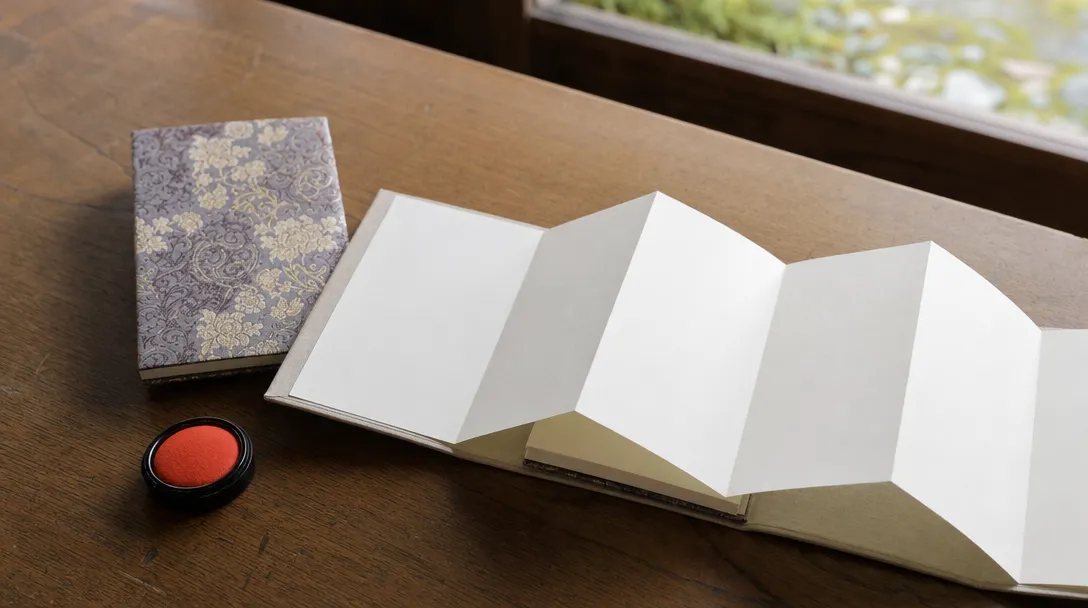
 Mikan's note: Buying a goshuincho at home before your trip? Choose an accordion-folded (jabara) one with thick washi paper so the ink does not bleed through – and if you plan to visit both temples and shrines, take two.
Because of this, the order matters: pay your respects first, then ask for the goshuin. Our guide to shrine and temple etiquette explains how to do that.
From sutra offerings to a record of travel
Goshuin did not begin as a souvenir. According to a commentary written for the Japan Tourism Agency’s multilingual database, pilgrims once offered a hand-copied Buddhist sutra to each temple (or recited one, or left an offering in its place), and the seal they received was the record of that offering. Collecting seals is thought to go back to the early 13th century, when pilgrims carried copies of the Lotus Sutra to temples in each of Japan’s 66 provinces. By the Edo period (1603–1867) the sutra offering had mostly faded, but the seals stayed popular. Sutra copying itself is still something visitors can join – see our guide to temple stays, zazen and sutra copying.
That history survives in a name: the office where you ask for a goshuin is often still called the nōkyōsho (納経所), literally “the place where sutras are offered”.
 Related guidesKyoto Experiences to Book: Tea, Kimono, Fushimi Inari and the 2026 Hotel Tax
Why no two goshuin are the same
Each goshuin is written by hand at that temple or shrine, so the brushwork and the seals change from place to place. Large temples go further. On Tōdai-ji’s official goshuin page (checked 19 October 2026), nine halls each give their own goshuin – 13 designs in all, from “Kegon” at the Great Buddha Hall to three different ones at the Shunjō-dō – and the Shukongōjin goshuin at the Hokke-dō is given only on 16 December. Two other halls are not giving goshuin for now: the Shigatsu-dō is closed for earthquake-proofing work, and the Kaidan-in Senju-dō’s special opening has ended.
Not every temple gives goshuin. Temples of the Jōdo Shinshū school usually do not, though some now offer a hōgo-in – a Buddhist phrase in calligraphy – instead, and at some small temples the person who writes goshuin is not always there, so the Japan Tourism Agency’s commentary on Teradomari (Niigata) recommends phoning ahead. Before you go, check the official website of the temple or shrine.
How to ask for a goshuin, step by step
- Visit the main hall and pay your respects.
- Find the office – look for signs saying 御朱印 (goshuin), 授与所 (juyosho) or 納経所 (nōkyōsho). At Meiji Jingu, for example, goshuin are received at the Nagadono office in front of the Kagura-den, from 9:00 until the gates close (the place can change on some days).
- Open your goshuincho to the next empty page and hand it over. Say “goshuin onegai shimasu” (a goshuin, please) or simply show the page.
- Pay the fee. It is set by each temple or shrine – at Tōdai-ji it is 300 yen per goshuin. Bring cash and, ideally, the exact amount: on the Chichibu pilgrimage in Saitama, for example, the offices give no change, so pilgrims carry plenty of 100-yen coins.
- Wait quietly while it is written, and receive the book back with both hands.
Opening hours: do not leave it too late
Offices close earlier than many visitors expect. Examples from official sites (checked 10 October 2026):
| Place | Where | Hours |
|---|---|---|
| Tōdai-ji (Nara) – Great Buddha Hall | at the hall | Apr–Oct 7:30–17:30, Nov–Mar 8:00–17:00 |
| Tōdai-ji – Hokke-dō and several other halls | at each hall | 8:30–16:00 |
| Zōjō-ji (Tokyo) | Ankoku-den | 9:00–17:00 |
| Meiji Jingu (Tokyo) | Nagadono office | 9:00 until the gates close (they close at sunset: 16:00 in December, 18:30 in June) |
At large temples such as Tōdai-ji, different halls give different goshuin, so plan which ones you want.
Where to buy a goshuincho: at the temple, in a shop or online?
There is no single “goshuincho shop” you need to find. Most travellers get their book in one of three ways, and each has a different trade-off:
| Where | What you get | Good for | Watch out for |
|---|---|---|---|
| The office of a temple or shrine | A book with that place’s own design; you can receive your first goshuin in it straight away | A book that starts with a place you really visited | Designs, sizes and stock differ from place to place; offices close in the late afternoon |
| A stationery or gift shop in Japan | Plain or patterned books, usually not tied to one temple | Choosing calmly before your first visit | Pick a real goshuin book (folded washi pages), not a notebook |
| Online, before you travel | A book delivered at home | Having it ready on day one, or a gift for someone going to Japan | You only see photos, so check the size and the format (accordion-folded or thread-bound) |
A real example of prices at a temple. Tōdai-ji in Nara lists its goshuin books on its official goshuin page (checked 31 October 2026): a purple design by Shinohara Tomoe and a camellia design for 2,500 yen each, and yellow, green and pink-floral books for 2,000 yen (large) or 1,500 yen (small) – the small ones have the same patterns as the large ones. Each goshuin there then costs 300 yen. So a large yellow, green or pink book plus your first goshuin comes to 2,300 yen.
Buying the book at your first stop has one practical advantage: you pay for the book and ask for your first goshuin at the same counter, during the same office hours (at Zōjō-ji in Tokyo, for example, goshuin are given at the Ankoku-den from 9:00 to 17:00). If you arrive near closing time without a book, you may miss both.
If you would rather choose at home, a proper goshuin book bought online or in a shop at home is used in exactly the same way: you open it to an empty page at the office. If you like paper goods, our guide to Japanese stationery covers the pens and notebooks worth buying while you are there.
How to choose a goshuincho (goshuin book)
- Format: there are two main types. Most are folded accordion-style (jabara), so the pages open out flat and you can see a whole run of goshuin at once; others are thread-bound (wa-toji) and open like a book.
- Size: larger books leave more space for the calligraphy; smaller ones are easier to carry.
- One book or two? Some people keep separate books for temples and shrines. The Japan Tourism Agency’s commentary notes that some temples and shrines may decline to write in a book that already holds seals from the other religion. If you are unsure, ask the office whether they can write in your book.
Pre-written goshuin (kakioki)
Some places give goshuin already written on a separate sheet (kakioki). At the Soshi-dō hall of Hōfuku-ji in Teradomari (Niigata), for example, goshuin are prepared only during the Tsuwabuki festival (usually mid-October to early November), as pre-written sheets left on a tray: you pay your respects, put 300 yen in the offering box and take one. You can paste a sheet like this into your book later.
Manners and things to avoid
- Ask for the goshuin after visiting, not instead of visiting.
- Do not ask for a goshuin in a regular notebook, a diary or on loose paper.
- Do not photograph the staff while they are writing unless you ask first.
- Goshuin are given as a record of an actual visit, so we do not recommend buying them from resellers or asking someone to collect them for you.
- Keep your goshuincho with care – not on the floor.
Read next: Temple Stay, Zazen and Sutra Copying in Japan: How to Book in English · Cultural Experiences in Japan: How to Choose and Book (Without Japanese)