 Eastbound Finds
Japanese banks are closed by law from 31 December to 3 January, and national government offices from 29 December. Yet Meiji Jingu in Tokyo does not close its gates at all on New Year’s Eve, and 7-Eleven’s ATMs keep working through the night. Hana here: this is the quick map of what shuts and what keeps going over New Year 2026–27, checked against official sources on 1 November 2026.
Key points
- Japan's national government offices are closed from 29 December to 3 January by law, and banks are closed from 31 December to 3 January; in 2026–27 bank counters reopen on Monday 4 January.
- Seven Bank ATMs inside 7-Eleven stores run 365 days a year, and Visa and Mastercard cards issued abroad work there 24 hours a day.
- Last New Year, Japan Post Bank ATMs (except small ones in convenience stores) stopped from 9 pm on 31 December to 7 am on 1 January, so withdraw cash before the evening of 31 December.
Show more
- Meiji Jingu stays open all night from New Year's Eve into New Year's Day; it is most crowded from 10 pm on 31 December to 3 am on 1 January and after 10 am on 1–3 January.
- The Imperial Palace opens to the public for the New Year Greeting on 2 January; in 2026 entry ran from 9:30 am to 2:10 pm with five appearances and a bag check at the gate.
What’s closed and what’s open over New Year in Japan
| Dec 29–30 (Tue–Wed) | Dec 31 (Thu) | Jan 1 (Fri, holiday) | Jan 2–3 (Sat–Sun) | |
|---|---|---|---|---|
| National government offices | Closed | Closed | Closed | Closed |
| Bank counters | Open | Closed | Closed | Closed |
| 7-Eleven (Seven Bank) ATMs | Open | Open | Open | Open |
| Japan Post Bank ATMs | Open | Until 9 pm (last year) | From 7 am (last year) | Open, shorter hours |
| Convenience stores | Open | Open | Open | Open |
| Big department stores | Open | Open, check hours | Usually closed | Many reopen Jan 2 or 3 |
| Tokyo National Museum | Closed | Closed | Open 12:00–20:00 | Open |
| National Museum of Western Art | Closed | Closed | Closed | Open |
| Kyoto National Museum | Closed | Closed | Closed | Open |
| Meiji Jingu | Open | Open all night | Open all night, until 18:30 | Open 6:40–18:00 |
Sources: e-Gov law database, Seven Bank, Japan Post Bank, Isetan Mitsukoshi and Takashimaya (2025–26 notices), Tokyo National Museum, National Museum of Western Art, Kyoto National Museum and Meiji Jingu (2026 edition of its New Year page), checked on 1 November 2026. “Last year” means the 2025–26 schedule; the 2026–27 one had not been published yet.
AdvertisingQuick pick: Hotels in Tokyo for New Year – Trip.com
 Mikan's note: Withdraw enough yen before the evening of 31 December – last year Japan Post ATMs paused overnight, and some cards with Visa or Mastercard logos are still refused. Check your hotel's New Year meal times too: some restaurants close from 31 December to 3 January.
Bank counters reopen on Monday 4 January 2027. Convenience stores are open 24 hours “in principle”, according to 7-Eleven, but some branches keep shorter hours, so do not count on the one next to a quiet station.
Getting cash: the ATM that keeps going
This is the detail that catches visitors out. Seven Bank, the bank behind the ATMs in 7-Eleven stores, says its machines can be used 365 days a year. Cards issued abroad on Visa (PLUS) and Mastercard (Maestro, Cirrus) work 24 hours; JCB, UnionPay and Discover work from 0:10 to 23:50. Seven Bank also notes that some cards with these logos may still be refused.
Japan Post Bank ATMs, found in post offices, also accept foreign Visa, Mastercard, JCB, UnionPay and Discover cards, up to ¥50,000 per withdrawal. But last New Year most of them (not the small machines in convenience stores) stopped from 9 pm on 31 December to 7 am on 1 January 2026. Japan Post Bank announced that schedule on 20 November 2025, so watch for this year’s notice around the same time.
 Related guidesJapan Autumn Leaves Forecast 2026: Peak Dates for Kyoto, Tokyo and Nikko
The Imperial Palace on 2 January
On 2 January the inner grounds of the Imperial Palace open to everyone for the New Year Greeting, when the Imperial family appears on the balcony of the Chōwaden hall. In 2026, the Imperial Household Agency listed five appearances, at about 10:10, 11:00, 11:50, 13:30 and 14:20. Entry was through the main gate (Seimon, by the Nijūbashi bridge) from 9:30 to 14:10, with a bag check. Suitcases and large bags have to go in a coin locker, and even small knives or scissors should be left behind. The agency also asks people not to start queuing on the evening of 1 January or before dawn. The 2027 details were not yet published on 1 November 2026, so check its page in December.
New Year’s Eve and the first shrine visit
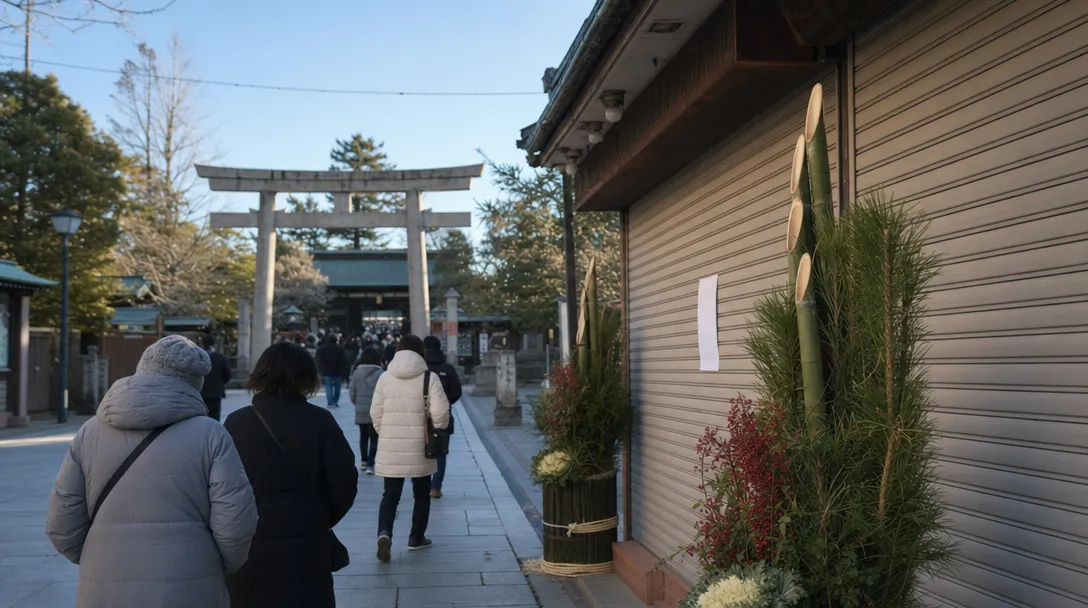
The first shrine or temple visit of the year, hatsumōde, is the main event of the night. Meiji Jingu keeps its gates open all night from 31 December into 1 January. It says the busiest times are usually 10 pm to 3 am that night and after 10 am on 1–3 January. At Sensōji in Asakusa, the temple bell starts ringing at midnight and is struck 108 times, which takes about 40 minutes. If this is your first visit to a shrine, our shrine and temple etiquette guide covers bowing, the water basin and photos.
Shibuya’s famous street countdown has been cancelled two years running: Shibuya City announced on 3 December 2025 that the event would not take place, and fenced off the area around the Hachikō statue on the night. Last year’s announcement came in early December, so check the city’s news before planning a midnight in Shibuya.
For getting home after midnight, JR East announced on 22 October 2026 that it will run extra trains on six lines around Tokyo after the last regular trains on 31 December, running into New Year’s Day. Check the times in December before you rely on them.
Shinkansen: the days to avoid
Long-distance trains are busiest just before and after the holiday. Last New Year, JR Central reported the peak days on the Tōkaidō Shinkansen as 27 December (leaving Tokyo) and 3 January (returning). Over the whole period, every seat on the fastest Nozomi trains was reserved-only, with no unreserved cars. JR’s figures for 2026–27 usually come out in mid-December; until then, book seats as early as you can if you must travel on those days.
Coming from the US or Europe? The calendar is flipped
In much of the West, the long break is Christmas and New Year’s Day is a single day off. Japan is the reverse. 25 December 2026 is an ordinary Friday – shops, offices and banks are open, as our guide to Christmas in Japan explains. The family holiday starts around 29 December and runs to 3 January; work restarts on 4 January, and the next public holiday is Coming of Age Day on 11 January 2027 (see our 2027 public holiday list). Plan your museum days for 29–30 December or after 2 January, and keep 1 January for shrines and walks.
What the weather is like over New Year
Tokyo’s January average is 5.4°C (42°F), with highs of 9.8°C (50°F) and lows of 1.2°C (34°F) (JMA normals, 1991–2020). It is usually dry and sunny. The sun sets at 4:38 pm on 1 January 2027, according to the National Astronomical Observatory of Japan, so a late-afternoon shrine visit ends in the dark.
| City | January average | Average high | Average low |
|---|---|---|---|
| Fukuoka | 6.9°C / 44°F | 10.2°C / 50°F | 3.9°C / 39°F |
| Osaka | 6.2°C / 43°F | 9.7°C / 49°F | 3.0°C / 37°F |
| Tokyo | 5.4°C / 42°F | 9.8°C / 50°F | 1.2°C / 34°F |
| Kyoto | 4.8°C / 41°F | 9.1°C / 48°F | 1.5°C / 35°F |
| Nagoya | 4.8°C / 41°F | 9.3°C / 49°F | 1.1°C / 34°F |
| Sapporo | -3.2°C / 26°F | -0.4°C / 31°F | -6.4°C / 20°F |
Source: JMA monthly normals, 1991–2020, checked on 1 November 2026. Fahrenheit is rounded.
A shrine queue at midnight means standing still outdoors near freezing, so bring a hat and gloves. Our November weather guide has more on layering.
So the department stores are closed on New Year’s Day – but what are the crowds lining up for when they open on the 2nd? The answer is the lucky bags called fukubukuro.