 Eastbound Finds
The most wanted Japanese lucky bags are spoken for long before New Year: Starbucks Japan’s 2026 bag was sold only by an online lottery that opened on 4 November 2025 and closed ten days later. These are fukubukuro (福袋) – sealed bags with surprise contents that shops sell at the start of the year, and in a 2025 survey of 5,403 people in Japan, half said knowing what’s inside still mattered. Below: where the custom may come from, three ways to get one from abroad, and the main New Year traditions with the 2027 card dates. If you want a bag for January 2027, the time to plan is now. Checked on 18 October 2026.
Key points
- Fukubukuro (福袋) are sealed lucky bags with surprise contents sold at the start of the year; there are several theories about where they began, including Edo-period kimono shops selling leftover fabric cheaply.
- In a 2025 online survey of 5,403 people in Japan, the most common lucky-bag budget was ¥5,000–10,000 (27.7%), and 49.7% said knowing the contents mattered when they buy.
- From abroad you can buy from Japanese shops that ship overseas (such as Tatsumura Textile, by EMS with duties paid by the buyer) or through a proxy service such as FROM JAPAN, but check the shop's own rules first.
Show more
- Starbucks Japan's Lucky Bag 2026 cost ¥8,800 including tax and delivery, was sold only by online lottery to My Starbucks members, had to be paid by 2 December 2025, and could not be cancelled or transferred after entry.
- For the 2027 New Year, Japan Post accepts New Year cards from 20 December 2026; cards posted by 27 December are delivered on 1 January, and cards are also delivered on 3 January.
Why are lucky bags called “fukubukuro”?
Fukubukuro (福袋) is made of two simple words: fuku (福), good fortune, and fukuro (袋), bag. The name is a play on luck – you pay for a sealed bag and hope fortune fills it.
AdvertisingQuick pick: Japanese lucky bags and snack boxes – Amazon.com
 Mikan's note: Before you order a lucky bag from abroad, remember that import tax and handling fees are added on arrival and an unopened surprise bag is hard to return. If it holds food, check your country's rules for importing food, since you can't see the ingredients until it arrives.
Nobody agrees on who sold the first one. Tobu Department Store says lucky bags are said to go back to the Edo period, when kimono shops – the forerunners of today’s department stores – collected fabric offcuts in bags and sold them cheaply. Odakyu Department Store’s column lists several theories: that Matsuya started them in the Meiji era, that Ito Gofukuten (today’s Matsuzakaya) did, and the story of Echigoya (today’s Mitsukoshi) selling “Ebisu bags” filled with leftover cloth. So the honest answer is: there are several theories, and most of them start with kimono merchants (another credits a tea shop in the Taishō era).
What do Japanese shoppers want in a lucky bag?
The surprise is the tradition, but buyers have become practical. An online survey by Kufu Company (28 November – 1 December 2025, 5,403 respondents) found:
| Question | Top answers |
|---|---|
| What matters when buying a lucky bag? | Price 61.1%, a favourite shop or brand 50.6%, knowing the contents 49.7% |
| Budget for a lucky bag | ¥5,000–10,000 was the most common answer (27.7%) |
| What do you want inside? | Food 46.6%, discount tickets or product vouchers 45.8% |
In other words, about half of buyers care about knowing what is inside, so it is worth looking for bags whose contents are listed before you pay. The same release notes that reservation and lottery-style lucky bags are increasing, so the queue at the shop door is no longer the only route.
 Related guidesValentine's Day and White Day in Japan: Who Gives Chocolate to Whom
Fukubukuro lucky bag: how to buy one from abroad
As of 18 October 2026, the 2027 lucky bags in the table below have not been announced; the examples are from the 2026 season. Checked on 18 October 2026.
| Route | Example | What the official pages say |
|---|---|---|
| Japanese shop that ships overseas | Tatsumura Textile (a long-established Kyoto weaving house), English online shop | Started selling limited “2026 New Year’s Lucky Bags” on 26 December 2025. Its terms say orders ship by EMS, the buyer pays customs duties and taxes, and returns are accepted within 7 days of receipt for unused items only. |
| Proxy shopping service | FROM JAPAN | Its blog (23 December 2025) says it accepts lucky-bag orders. Stock is limited: if a bag sells out before the purchase, the order cannot be processed and is refunded in full. It also warns that Starbucks bags are lottery-only. |
| Bag shipped only to the entry address | Starbucks Japan Lucky Bag 2026 | Lottery for My Starbucks members; delivered to the address you specify. The rules do not mention overseas shipping or say whether a proxy may enter for you. |
Before you use a proxy service, read the original shop’s terms: check that resale or proxy purchase is not forbidden, and whether the lottery must be entered under your own membership account. If the rules forbid transfer, a proxy is not an option.
Example (official rules): Starbucks Japan’s Lucky Bag 2026 was sold only by online lottery. Entry ran from 10:00 on 4 November to 23:59 on 14 November 2025, was limited to My Starbucks members, one entry per person, and winners were announced on 25 November. The bag cost ¥8,800 including tax and delivery, payment was due by 23:59 on 2 December 2025, and delivery dates were chosen from 1–7 January 2026. Entries cannot be cancelled after they are completed, returns are not accepted except for defects, and the winning right cannot be transferred to anyone else. Starbucks usually opens its lottery in early November; the 2027 bag had not been announced on 18 October 2026.
Import costs. When a bag arrives from Japan, your country may charge import tax, customs duty and a carrier handling fee, and Tatsumura’s terms state that these are paid by the buyer. Check your own customs authority’s website before ordering. If you’d rather have a Japanese surprise box every month instead of once a year, compare Japanese snack subscription boxes; for one-off presents that ship abroad, see Japanese gifts you can buy online.
Visiting Japan at New Year? Buying in person on 1–2 January, when the New Year sales start, is the simplest way – go early.
When is New Year in Japan?
Japan celebrates New Year on 1 January, like most Western countries – not at the Lunar New Year. Only 1 January is a public holiday, but many companies and small restaurants close from about 29–31 December to 3 January, and many people travel to their hometowns. The season starts right after Christmas in Japan, when 25 December is still a normal workday. Our New Year holiday guide shows what is closed and what stays open on each of those days, from banks to museums.
| Date | What happens |
|---|---|
| From 20 December | Japan Post starts accepting New Year cards (nengajō) for 2027 |
| By 27 December | Post New Year cards to have them delivered on 1 January 2027 |
| 31 December (Ōmisoka) | Toshikoshi soba noodles, TV music shows, temple bells at midnight |
| 1 January | Public holiday. First sunrise (hatsuhinode), first shrine or temple visit (hatsumōde), osechi with family |
| 1–3 January | Family visits, pocket money for children (otoshidama), New Year sales and fukubukuro |
Japanese New Year traditions
- Toshikoshi soba – long buckwheat noodles eaten on New Year’s Eve to say goodbye to the old year.
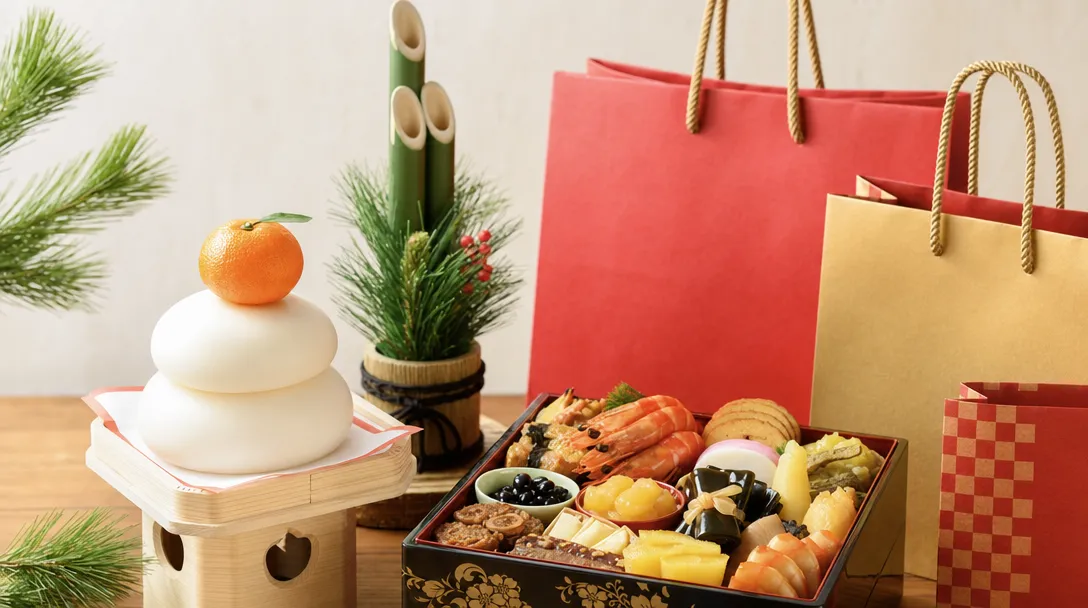
- Osechi – colourful dishes packed in lacquered boxes, prepared in advance so that people can rest in the first days of the year. Many families now order osechi from department stores or convenience stores.
- Ozōni – a soup with rice cake (mochi); the recipe differs by region. Mochi is very sticky: cut it into small pieces and take care with children and older people.
- Hatsumōde – the first visit of the year to a shrine or temple. Popular shrines are extremely crowded on 1–3 January. If you go, read our guide to shrine and temple etiquette first.
- Nengajō – New Year postcards. For the 2027 New Year, Japan Post changed its dates: it accepts cards from 20 December 2026 (previously 15 December), cards posted by 27 December 2026 (previously 25 December) are delivered on 1 January, and cards are also delivered on 3 January 2027. New Year postcards are on sale from 2 November 2026 to 15 January 2027.
- Otoshidama – money given to children in a small decorated envelope.
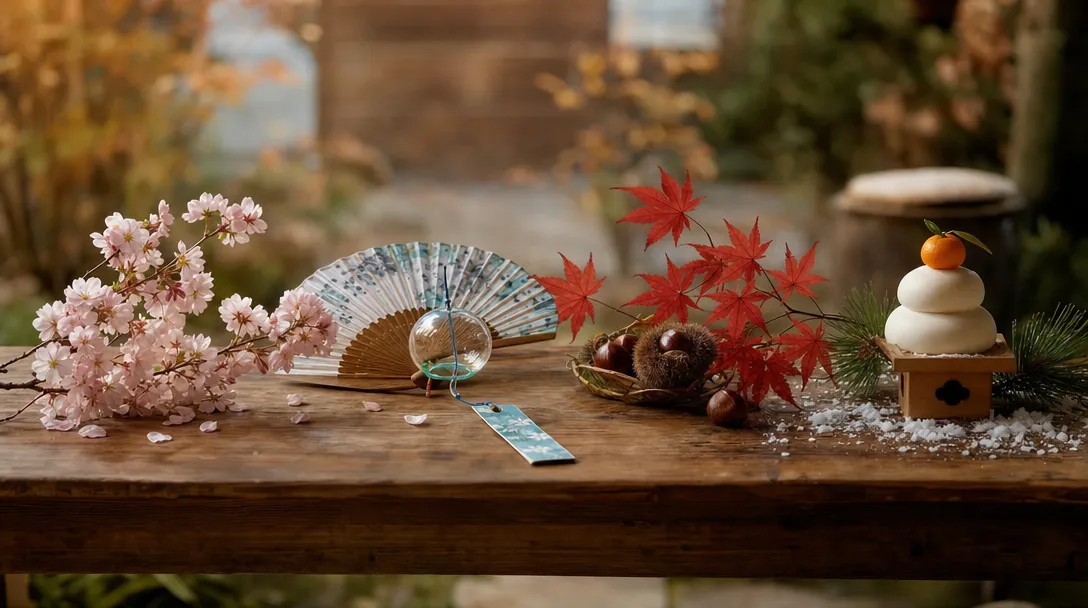
- Kadomatsu and kagami mochi – pine-and-bamboo decorations at entrances and stacked rice cakes at home.
For other seasonal events through the year, see the Japanese festivals calendar.
Ordering something from Japan before then? Japan Post’s Christmas deadlines come first – which gifts still arrive by 24 December? See Christmas gifts from Japan.