 Eastbound Finds
In Japan, Valentine’s Day is mostly a chocolate day, and traditionally women do the giving. People who received chocolate then give something back a month later, on White Day (14 March). This guide explains who gets what kind of chocolate, where White Day came from, how the custom is changing, and what it means if you are in Japan in February or want Japanese chocolate at home. Checked on 12 October 2026.
Key points
- In Japan, Valentine's Day (14 February) is traditionally the day when women give chocolate, and White Day (14 March) is when the people who received chocolate give a return gift.
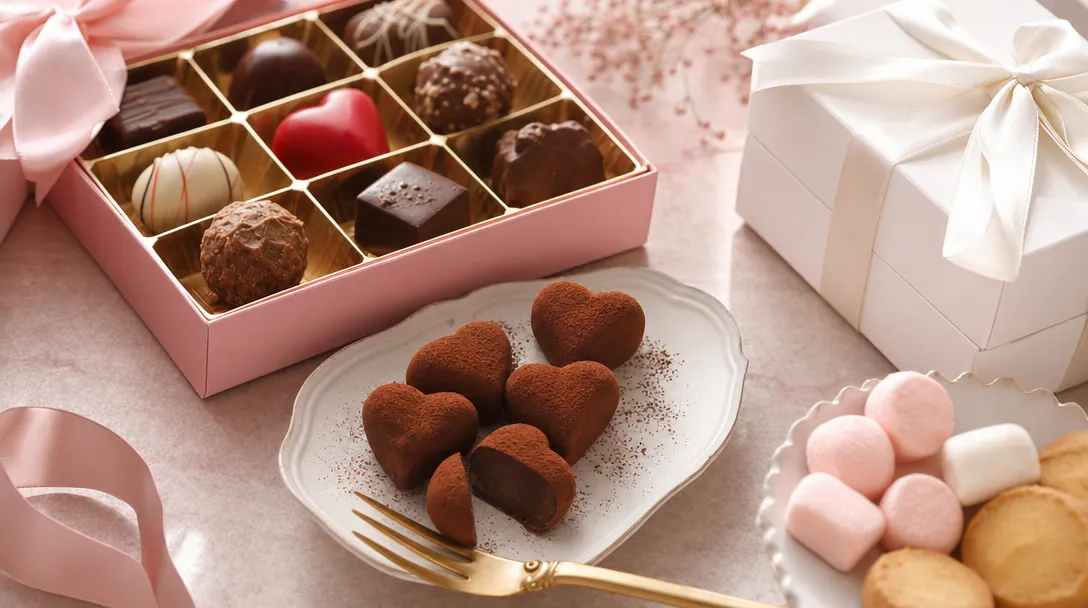
- Japanese Valentine chocolate has names by recipient: honmei choco for a partner or crush, giri choco for colleagues out of courtesy, tomo choco for friends, and chocolate bought for yourself.
- Giri choco at work is fading: in INTAGE's January 2026 survey of 5,000 people, 85.4% of working women said they would rather not take part in workplace giri choco.
Show more
- According to the Japan Candy Manufacturers' Cooperative, it chose 14 March as a day for giving candy in 1978, and the first White Day campaign ran on 14 March 1980.
- Neither day is a public holiday; from mid-January, big department stores hold chocolate fairs that visitors can walk into.
Who gives chocolate to whom?
The Japanese words for Valentine chocolate depend on who it is for. This is the part that surprises most visitors.
AdvertisingQuick pick: Yuraku Black Thunder Mini Bars Bag (3 Pack) – Amazon.com
| Name | Who it is for | What it usually looks like |
|---|---|---|
| Honmei choco (本命チョコ, “true feeling”) | A partner, spouse or crush | A special box from a department store, or handmade chocolate |
| Giri choco (義理チョコ, “obligation”) | Colleagues, bosses, classmates | Inexpensive chocolate, sometimes a shared box for the whole office |
| Tomo choco (友チョコ, “friend”) | Friends, often between women and girls | Small packs to swap, often homemade |
| Jibun choco (自分チョコ, “for myself”) | Yourself | A treat from a brand you would not buy every day |
| Family | Husband, children, parents | Anything from a supermarket bar to a nice box |
The chocolate is the gift itself. Flowers, cards and dinner reservations are less central than in the US, although couples do go out on 14 February.
How it is changing: less giri choco, more chocolate for yourself and family
Workplace giri choco has become unpopular. In INTAGE’s Valentine’s Day survey (online, 14–19 January 2026, 5,000 people aged 15–79, published 30 January 2026):
- 85.4% of working women said they would rather not take part in giri choco at work – the highest since the question was first asked in 2022.
- 42.8% of women said they did not plan to give anything themselves, up 4.0 points on the previous year.
- 38.7% of women planned to give to family (down 4.4 points), and 21.3% planned to buy chocolate for themselves (about the same as the year before).
- Women buying chocolate gave an average budget of ¥4,943, and many said rising chocolate prices were the reason it went up.
So if you work in Japan, do not assume you must hand out chocolate to the whole office. Customs differ from workplace to workplace; ask a colleague or follow what others do.
 Related guidesChristmas in Japan 2026: A Workday With KFC and Pre-Ordered Cake
White Day on 14 March: where it came from
White Day is a Japanese invention. According to the Japan Candy Manufacturers’ Cooperative (全国飴菓子工業協同組合), the industry body of Japanese candy makers:
- In the 1970s, as Valentine’s Day spread, young people began giving return gifts, and individual confectioners promoted their own “return days” with marshmallows, cookies or candy.
- At its general meeting in Nagoya in 1978, the cooperative decided to make 14 March a day for giving candy as a reply to Valentine’s Day.
- The name “White Day” was chosen because white stands for purity, which the cooperative felt suited young love. Before that, names such as “Flower Day” and “Cookie Day” were used.
- The first White Day was 14 March 1980. In the run-up, on 8–9 March, the cooperative held a pre-campaign that included a candy sales corner in the basement of Mitsukoshi in Ginza.
As the cooperative itself says, other confectioners were already promoting return days before 1980, so this is the candy industry’s account of how the name and date became fixed.
What people give today: candy, cookies, marshmallows, chocolate, or a small present. You may see a rule that White Day gifts should be “three times” the value of the Valentine’s gift, or that each sweet carries a hidden meaning. Neither appears in the cooperative’s explanation. Give something similar in value, and add a note if you want to be clear.
How is this different from the US?
| Japan | United States | |
|---|---|---|
| Who gives | Traditionally women; men reply on White Day | Both partners, often the man too |
| Main gift | Chocolate | Cards, flowers, chocolate, dinner |
| Gifts to colleagues | Giri choco (fading) | Rare |
| A second day in March | White Day, 14 March | None |
If you are dating someone Japanese, there is no rule that you must follow the Japanese pattern. Many international couples simply both give gifts. But if a Japanese colleague gives you chocolate, a small gift on 14 March is the polite reply.
February to March, step by step
- Mid-January: department stores open Valentine chocolate fairs. In 2026, Isetan Shinjuku’s Salon du Chocolat ran in three parts between 15 January and 15 February (Main Building, 6th floor). Dates and formats change from year to year, so check the official page for the next fair.
- Early February: supermarkets and convenience stores fill up with Valentine displays and baking kits for homemade chocolate.
- 14 February: the day itself. It is a normal working day; restaurants may be busy in the evening.
- Late February – early March: shops start selling White Day gifts.
- 14 March: White Day. Also a normal working day.
In Japan in February? What you can actually do
- Walk around a chocolate fair. The fairs are held on department store event floors, but entry rules vary: at Isetan Shinjuku’s 2026 fair, entry from opening until 11 a.m. was for store card members with an advance booking, and two days were for invited card members only. Check the official page for dates, entry rules and brands before you go.
- Buy for yourself without awkwardness. Jibun choco is normal, so nobody will think it odd that you are buying a box for yourself.
- Taking chocolate home: filled chocolates and nama chocolate (soft ganache) can melt. ROYCE’, for example, says its nama chocolate must be kept in a refrigerator at 10°C or below and has a best-before period of one month. Ask the shop about an ice pack and keep it in the coolest part of your bag.
- For other seasonal events, see the Japanese festivals calendar. If you are curious how another imported holiday turned out in Japan, read Christmas in Japan.
Getting Japanese chocolate in the US
Everyday Japanese chocolate is the easiest to find. Bars such as Meiji’s chocolate and Yuraku’s Black Thunder are sold on Amazon.com, usually by third-party sellers (checked 12 October 2026). Check the seller, the best-before date and how the item ships before you order, especially in warm months. Department store fair exclusives and chilled nama chocolate are a different matter: check whether the shop ships to the US at all before you plan around them.
US customs: since 29 August 2025, the $800 duty-free “de minimis” rule is suspended, and CBP says all applicable duties, taxes and fees must be paid on low-value shipments, including international mail (CBP e-commerce FAQ, last modified 2 September 2026). Genuine gifts valued at $100 or less sent by a person still have their own exemption (CBP, June 2026). If you order from a Japanese shop, the parcel is a purchase, not a gift, so expect duty and possibly a carrier fee. Check the CBP website before you order, as these rules have been changing.
For other ideas and how to order from Japan, see Japanese gifts you can buy online and weird Japanese snacks.
When not to bother
If you are in Japan only for a short trip and not interested in sweets, Valentine’s Day will not change much for you: sights and transport run as usual. And if chocolate is mainly a gift for someone in the US, an American chocolatier may be simpler than shipping from Japan – unless the point is the Japanese flavour.