 Eastbound Finds
Hana here: in October 2025, top-division sumo wrestlers fought for five days at London’s Royal Albert Hall – the first Grand Sumo in London since 1991, 34 years earlier. If that got you curious, the real thing happens six times a year in Japan, and tickets for each tournament go on sale one to two months before it starts. Below are the 2027 dates, the new Tokyo seat prices, how to buy safely and how to see morning practice (all checked on the Japan Sumo Association’s official sites on 27 October 2026).
◎ Language: No translator needed (English available)
The official ticket site has an English version (Ticket Oosumo English) and the Japan Sumo Association's ticket guide is in English; stable visits are arranged by tour companies in English. (Checked: )
Key points
- Professional sumo holds six 15-day tournaments a year: Tokyo (Ryōgoku Kokugikan) in January, May and September, Osaka in March, Nagoya in July and Fukuoka in November.
- The 2027 tournaments start on 10 January, 14 March, 9 May, 11 July, 12 September and 14 November; tickets for January 2027 go on sale on 5 December 2026.
- From January 2027, a Kokugikan C chair seat costs ¥5,000 per person on weekdays (D seats ¥3,000); box seats are sold as whole boxes, with box C at ¥9,500 per person on weekdays.
Show more
- Buy only from Ticket Oosumo (official, with an English site) or its official face-value resale: in 2025 the Japan Sumo Association suspended ticket-site and fan-club memberships and cancelled tickets, refusing entry, in a total of 138 cases.
- JNTO says walk-in visits to sumo stables are not encouraged; book a small-group tour, or watch for the free public practice the Association sometimes holds at the Kokugikan (1 May 2026, from 8 am).
This official video from the Japan Sumo Association shows the London shows, from the ring entrance to the wrestlers sightseeing around the city:
When are the sumo tournaments? 2027 dates and ticket sale days
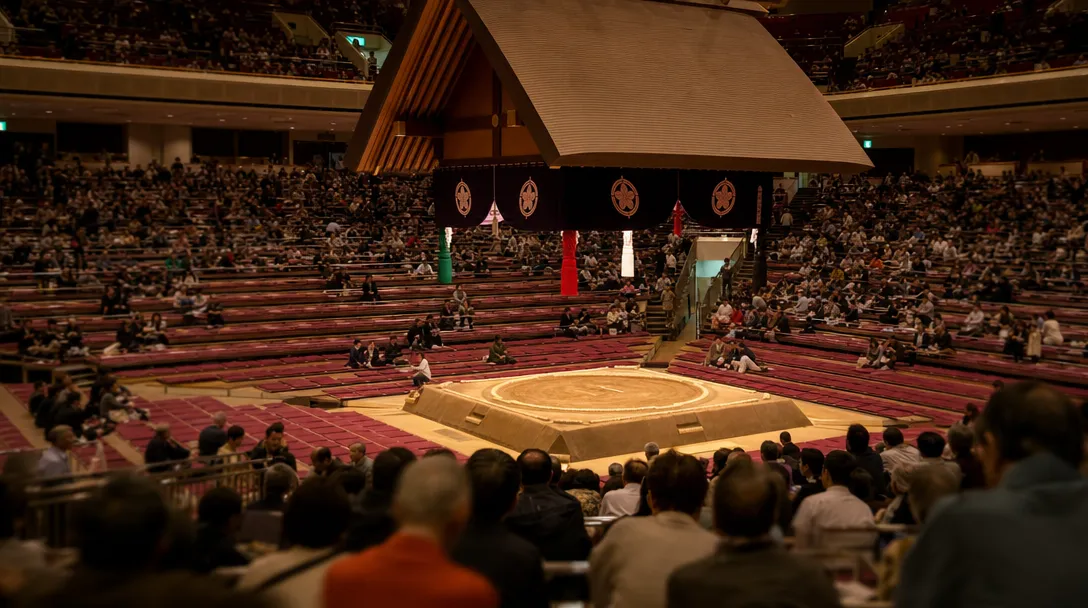
A professional tournament (honbasho) lasts 15 days, from a Sunday to a Sunday two weeks later. Three of the six are in Tokyo, at the Ryōgoku Kokugikan.
AdvertisingQuick pick: Sumo experiences in Tokyo: tournament tours, stable morning practice and sumo shows – GetYourGuide
 Mikan's note: Seen sumo tickets for sale on a reseller site at three times the price? Skip it: the Japan Sumo Association cancels resold tickets and refuses entry. If you can't go, use the official face-value resale on Ticket Oosumo.
| Tournament | Venue | Tickets on sale | Dates |
|---|---|---|---|
| January 2027 | Ryōgoku Kokugikan, Tokyo | 5 Dec 2026 | 10–24 Jan 2027 |
| March 2027 | EDION Arena Osaka | 6 Feb 2027 | 14–28 Mar 2027 |
| May 2027 | Ryōgoku Kokugikan, Tokyo | 10 Apr 2027 | 9–23 May 2027 |
| July 2027 | IG Arena, Nagoya | 15 May 2027 | 11–25 Jul 2027 |
| September 2027 | Ryōgoku Kokugikan, Tokyo | 7 Aug 2027 | 12–26 Sep 2027 |
| November 2027 | Fukuoka Kokusai Center | 18 Sep 2027 | 14–28 Nov 2027 |
Source: Japan Sumo Association tournament schedule, checked 27 October 2026. The 2028 dates are already published on the same page.
The November 2026 tournament in Fukuoka (8–22 November) is already sold out on every day, according to the official ticket site – a good reason to mark the sale day in your calendar.
How much are sumo tickets? New Kokugikan prices from 2027
You choose between two kinds of seat. Box seats (masu-seki) are low boxes on the floor where you sit on cushions, close to the ring; they are sold as a whole box (usually for four people). Chair seats are like the seats in any sports stadium.
The Japan Sumo Association is raising Tokyo and Osaka prices from the January 2027 tournament (Nagoya and Fukuoka stay the same). New Kokugikan prices, per person, tax included:
| Seat at the Kokugikan (Tokyo) | Weekday | Weekend & holidays | Day 14 & final day |
|---|---|---|---|
| Chair seat C | ¥5,000 | ¥6,000 | ¥7,000 |
| Chair seat B | ¥6,000 | ¥7,000 | ¥8,000 |
| Chair seat A | ¥10,000 | ¥11,000 | ¥12,000 |
| Chair seat S | ¥11,000 | ¥12,000 | ¥13,000 |
| Box seat C (per person) | ¥9,500 | ¥10,500 | ¥11,500 |
| Box seat B (per person) | ¥11,000 | ¥12,500 | ¥14,000 |
Source: Japan Sumo Association price list for the January 2027 tournament onwards (published 30 July 2026), checked 27 October 2026.
The same list also has D chair seats at ¥3,000 for adults. So a four-person box C on a weekday is ¥38,000 in total. Day 14 and the final day now have their own, higher price.
 Related guidesGoshuin Stamps in Japan: How to Ask, Costs and Where to Buy a Goshuincho
How to buy sumo tickets (and the resale trap)
- Check the sale date in the table above.
- Buy on Ticket Oosumo, the official site run with Ticket Pia. It has an English version, and for the November 2026 tournament it also ran an international advance lottery for overseas buyers, so look at the English page before the sale day.
- Check payment and pick-up before you buy. Each tournament has its own “Buying Tickets” page on Ticket Oosumo English that lists how to pay and how to get your tickets, so read it for your tournament.
The useful thing to know: the Japan Sumo Association’s rules ban reselling tickets for profit. Its notice names ticket resale sites including viagogo, StubHub and “Buy Sumo Tickets”, and says resold tickets may be cancelled and their holders refused entry. In 2025 it took action in a total of 138 cases across the six tournaments – suspending Ticket Oosumo and fan-club memberships and cancelling tickets, so their holders were refused entry. Common problems it lists: tickets that never arrive, tickets for the wrong day, and a “box for four” that turns out to be one ticket (each person in a box needs their own ticket).
If you can’t go, or missed the sale, use the official face-value resale on Ticket Oosumo, where tickets change hands at the original price.
Can you buy tickets on the day?
Sometimes. JNTO says the box office sells tickets on the day of a tournament, but many days sell out. For the sold-out November 2026 tournament, the official ticket site says plainly that there will be no tickets on the day. Buy ahead if you’re travelling for it.
What time to arrive, and what happens in a box seat
You don’t need to be there when the doors open. A tournament day runs from morning to evening, and the official ticket site’s page for the January 2026 Tokyo tournament gives the shape of it:
| Ryōgoku Kokugikan (January 2026 tournament) | |
|---|---|
| Doors open | 8:45 am (10:30 am on days 13 and 14, 10 am on the final day) |
| Top-division main matches | Start around 2 pm |
| Bouts finish | Around 6 pm |
| Re-entry | Once only, back by 5 pm |
Source: Ticket Oosumo English, January 2026 tournament page, checked 27 October 2026. The 2027 pages are not up yet, so check yours before you go.
So for most visitors, arriving in the early afternoon is enough to see the top wrestlers, with time to eat first. Re-entry rules are not the same everywhere: the Kokugikan guidebook says you can go out and back in once a day through the South Gate (keep your ticket stub, or show the QR ticket on your phone), while the page for the November 2026 tournament in Fukuoka says you can re-enter as many times as you like, back by 5 pm.
A few moments are worth timing your seat for. The Association’s own Kokugikan guidebook (September 2026 edition) points them out:
- The top-division ring-entering ceremony (makuuchi dohyō-iri): the wrestlers come in wearing embroidered aprons – from the east side on odd-numbered days and from the west on even-numbered days.
- The bow ceremony (yumitori-shiki): after the day’s last bout, a wrestler twirls a bow in a short ritual that the guidebook calls the winner’s dance.
- The drums as you leave (hane-daiko): the sound you hear as you leave the Kokugikan, a wish to see you back the next day – except on the final day, when there is no next day.
Hungry? The guidebook lists “special chanko” in the basement hall, made from a sumo stable’s recipe, at ¥500 a bowl (September 2026, 11 am to 4:30 pm).
Shoes off in a box seat
If you bought a box seat (masu-seki), you take off your shoes and sit on the square cushions inside the box – four people to a standard box, according to Ticket Oosumo. The guidebook’s “first-time box seat guide” says to put your shoes, and your umbrella, in the storage space at the back of your own box. Shoes that slip off easily make this much simpler.
The same guidebook has a short list of manners for every seat: no floor chairs, keep quiet at the tachiai (the moment the wrestlers charge – the referee lowers himself and points his fan to the front just before it), don’t stand in the aisles or block other people’s view, and don’t throw anything.
How a sumo bout works: how to win, and what the ranks mean
Sumo has 82 official winning techniques, yet two of them decide about half of all bouts. The Japan Sumo Association’s own tally of 192,672 bouts (January 2013 to the September 2026 tournament) puts the push-out (oshidashi) at 25.17% and the force-out (yorikiri, body pressed against the opponent, walking him out) at 24.92%. So when you watch, keep your eyes on the edge of the ring.
How do you win a sumo bout?
There are only two ways, as JNTO puts it: force your opponent to step outside the ring, or make him touch the ground with any part of the body other than the soles of his feet. The Association names 82 winning techniques (kimarite) for how it was done, plus five “non-techniques” for the bouts a wrestler loses on his own:
| Non-technique | What happened |
|---|---|
| Isamiashi | Driving his opponent to the edge, he steps out first himself |
| Fumidashi | His foot goes out of the ring with no force from his opponent |
| Tsukite / Tsukihiza | His hand / knee touches the ring with no force from his opponent |
| Koshikudake | He loses his balance and falls on his hips although his opponent made no move |
Each bout starts with a ritual of throwing purifying salt and bowing to each other before the charge (tachiai). Many bouts are over in seconds, though some go on for several minutes (JNTO). The referee (gyōji) rules on the bout, but at tournaments the Association’s Judging Division is in charge of deciding wins and losses – the same division that makes the match-ups. Referees have ranks too: the two at the top are Kimura Shōnosuke and Shikimori Inosuke.
What do the sumo ranks mean?
Every wrestler’s place is set on the ranking list (banzuke), and each rank has an East and a West side. This is the top division on the November 2026 list:
| Rank (top division) | November 2026 |
|---|---|
| Yokozuna (grand champion) | Onosato, Hoshoryu (born in Mongolia) |
| Ōzeki | Aonishiki (Ukraine), Kotozakura, Kirishima (Mongolia) |
| Sekiwake | Fujinokawa, Atamifuji |
| Komusubi | Churanoumi, Yoshinofuji |
| Maegashira | No. 1 to No. 17, East and West |
Below the top division (makuuchi) come five more: jūryō, makushita, sandanme, jonidan and jonokuchi. The top-division bouts are the ones that start around 2 pm in the timetable above. A new yokozuna is recommended by the Yokozuna Deliberation Council, a panel of experts from outside the Association.
Sources: Japan Sumo Association – 82 winning techniques and ranking, November 2026 banzuke (English), organisation and referee list; JNTO, Experience Sumo. Checked 27 October 2026.
How to see sumo morning practice
Outside the tournament hall, wrestlers train in the morning at their stables (heya). It is tempting to just walk up – but JNTO says casual, spontaneous visits are not encouraged, and that some travel agencies arrange tours for small groups, where visitors typically watch the wrestlers practise their moves and build strength.
There is one free way in. In 2026 the Association opened the Yokozuna Deliberation Council’s practice session at the Kokugikan to the public on 1 May: free entry, doors from about 8 am, practice until about 11 am, no seat reservations. Its rules give you a feel for practice etiquette in general:
- Watch quietly and don’t use your phone in the hall.
- Take photos and video only from your seat, and never for commercial use.
- No alcohol; once you leave, you can’t come back in.
Announcements like this appear on the Association’s news page, so check it before a Tokyo tournament.
If you’d rather see wrestlers up close with a meal, Tokyo also has sumo shows by retired wrestlers, often with chanko-nabe, the hot pot wrestlers eat. They’re entertainment rather than real practice – the listings themselves say so. For how sumo compares with tea ceremony, kimono and other experiences, see our guide to cultural experiences in Japan.
Sumo outside Japan: London, Paris and next, Bangkok
People searching for “sumo London 2026” or “sumo Paris 2026” are usually chasing the overseas shows. Here is what the Japan Sumo Association has announced:
- London: Royal Albert Hall, 15–19 October 2025 – the first since 1991. No new London dates are on the official site as of 27 October 2026.
- Paris: Accor Arena, 13–14 June 2026 – the third Paris show after 1986 and 1995. Finished.
- Bangkok: One Bangkok Forum, 11–13 June 2027, for 140 years of Japan–Thailand relations. Details to follow.
Nippon TV’s news report from London shows how the city reacted:
Grand Sumo takes over London: crowds excited by the first show in 34 years (NTV News)
From home, NHK WORLD-JAPAN broadcasts GRAND SUMO Highlights in English during tournaments, with play-by-play commentary on the day’s bouts.
Where to stay and what else to plan
The Kokugikan is in Ryōgoku, east Tokyo; if you’re booked on an early stable tour, a hotel on the east side saves time. To see what else is on in the month you pick, our Japanese festivals calendar goes month by month, and a Tokyo food tour fills the evening after the last bout.
Going to the January tournament? It comes right after the New Year sales, when shops sell sealed fukubukuro bags whose contents you only see after buying – so what is actually inside a Japanese lucky bag? Here’s how they work.