 Eastbound Finds
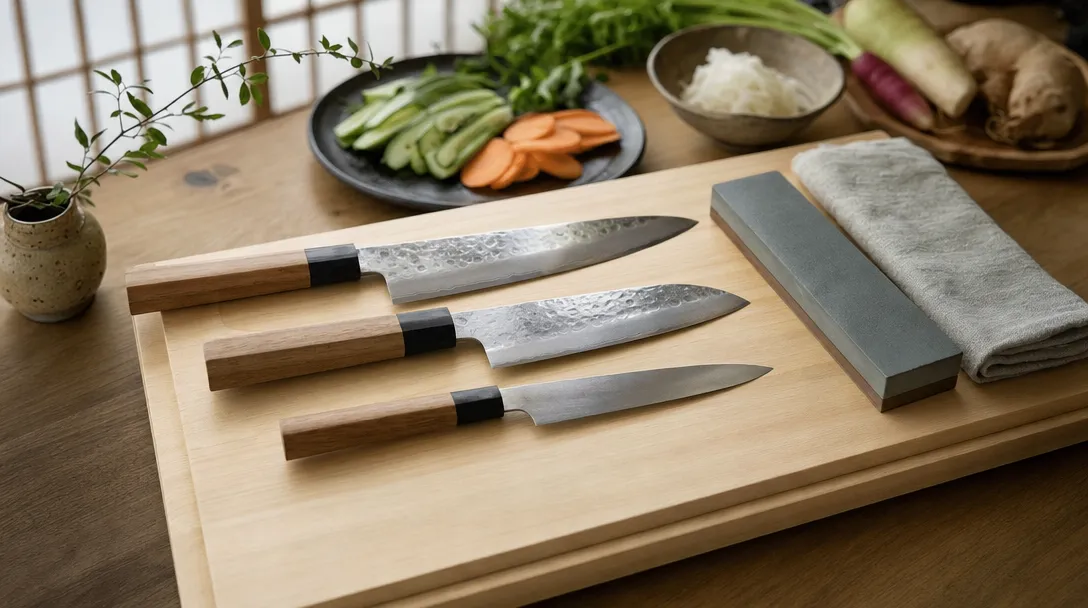
For a first Japanese knife, pick a santoku (about 16–18 cm) if you mostly cut vegetables, or a gyuto (about 18–24 cm) if you want a longer all-round chef’s knife. And if you buy one in Japan, know this first: carrying a blade longer than 6 cm without a legitimate reason is illegal there, and police guidance counts “buying it and taking it home” as a reason, while sightseeing with it in your bag is not. Below: single and double bevel, carbon vs stainless steel, and how to care for and sharpen your knife. Checked on 9 October 2026; the carrying rules on 22 October 2026.
Key points
- For a first Japanese knife, a santoku (about 16–18 cm) or a gyuto (about 18–24 cm) covers most home cooking.
- A santoku has a flatter edge for up-and-down cutting; a gyuto is longer with a pointed tip and works like a Western chef's knife.
- Traditional knives such as deba, yanagiba and usuba are single-bevel, so left-handed cooks need a left-handed version.
Show more
- Carbon steel rusts if left wet; stainless is easier. Wash any Japanese knife by hand and dry it straight away.
Types of Japanese knives
| Knife | Typical length | Edge | Best for |
|---|---|---|---|
| Santoku | about 16–18 cm | Double bevel, flatter edge | Vegetables, meat and fish at home – an all-rounder |
| Gyuto (Japanese chef’s knife) | about 18–24 cm | Double bevel, curved edge, pointed tip | Meat, fish, larger vegetables; works like a Western chef’s knife |
| Nakiri | about 16–18 cm | Double bevel, straight edge | Vegetables |
| Petty | about 12–15 cm | Double bevel | Small jobs, fruit, herbs |
| Deba | various | Single bevel, thick spine | Cutting up whole fish |
| Yanagiba | long and thin | Single bevel | Slicing raw fish for sashimi and sushi |
| Usuba | rectangular | Single bevel | Fine vegetable cutting |
Lengths are typical ranges; each maker uses its own sizes.
AdvertisingQuick pick: Tojiro Pro santoku knife, 170 mm – Amazon.com
Santoku vs gyuto: which Japanese knife should you buy first?
- Santoku – shorter, with a flatter edge and a rounded tip. Good for up-and-down cutting and for small kitchens. The name is often explained as “three uses” (vegetables, meat, fish).
- Gyuto – longer, with a curved edge and a sharp tip. Good if you are used to a Western chef’s knife or cut a lot of meat.
If you are unsure, a santoku is easy to start with. Later, a small petty knife is a useful second knife.
 Related guidesTakoyaki maker, kakigori machine, taiyaki pan: Japanese festival food at home
Single bevel vs double bevel
A double-bevel knife is sharpened on both sides – most santoku, gyuto and nakiri sold abroad are like this, and they work for right- and left-handed cooks. A single-bevel knife is sharpened on one side only. This is the traditional Japanese style for deba, yanagiba and usuba. They are made for one hand, so left-handed cooks need a left-handed version.
Carbon steel vs stainless steel
| Carbon steel | Stainless steel | |
|---|---|---|
| Sharpness and sharpening | Takes a very fine edge, easy to sharpen | Good edge; depends on the steel |
| Rust | Rusts and discolours if left wet | Resists rust much better |
| Care | Dry right after use, a thin coat of oil if stored | Wash and dry |
| Who it suits | People who enjoy caring for their tools | Most home cooks |
Some knives have a hard core steel covered by softer stainless steel, which gives a sharp edge with easier care.
Where are Japanese knives made?
Several Japanese regions have a long knife-making tradition, for example Sakai (Osaka), Seki (Gifu), Echizen (Fukui) and Tosa (Kochi). Sakai City says “Sakai uchihamono” (forged knives from Sakai) was designated a national traditional craft on 5 March 1982, and that forging, sharpening and handle fitting are done by separate specialists. A region name tells you where a knife is made, not how good it is. Fukui is also home to Obama, which has the top share of Japan’s lacquered chopstick production; see how to tell Japanese chopsticks made in Japan.
How to care for a Japanese knife
- Wash by hand and dry straight away. Do not put it in the dishwasher.
- Do not cut bones or frozen food, and do not twist the blade – the thin, hard edge can chip.
- Use a wood or plastic board, not glass, stone or ceramic.
- Store it safely – in a knife block, on a magnetic strip or with a blade guard.
How to sharpen a Japanese knife
Most Japanese knives are sharpened on a whetstone. A medium stone (around grit 1000) is used for regular sharpening, and a finer stone (for example grit 3000–6000) for finishing. Follow the knife maker’s instructions for the angle. If you do not want to sharpen yourself, many knife shops offer a sharpening service.
Buying a knife in Japan: the 6 cm rule
If you buy a knife in Japan, for example on Kappabashi kitchen street in Tokyo, one law matters more than any shop tip. Japan’s Swords and Firearms Control Law bans carrying a blade longer than 6 cm without a legitimate reason, and almost every kitchen knife is longer than that. Prefectural police guidance gives “buying it and taking it home” as an example of a legitimate reason, so the purchase itself is fine. What is not fine is carrying it around for the rest of the day.
- Ask the shop to keep the knife in its box or wrapped, and go straight to your hotel.
- Do not take it to restaurants, shrines or crowded events later that day. A blade of 6 cm or less can still be a minor offence if carried hidden without a reason.
- At the airport, put it in your checked suitcase. ANA says all blades, including knives, are banned from the cabin, and breaking this rule can mean up to 2 years in prison or a fine of up to 1,000,000 yen under the Civil Aeronautics Act (checked 16 October 2026).
- Plan the shopping for your last day in that city if you can, so the knife spends as little time as possible in your bag.
Shop in Japan or order online? Buying in a shop lets you hold the knife and feel its weight, and some shops engrave your name. Ordering online means none of the above: no carrying rules, no checked bag, no extra weight in your suitcase. If you already know the model you want, having it delivered to your home is often the easier choice; see “Buying a Japanese knife online” below.
Buying a Japanese knife online
- Check whether the knife is single or double bevel and, for single bevel, right- or left-handed.
- Check the steel and whether it is stainless.
- Shops may ask you to confirm your age when you buy a knife online.
- Many countries restrict carrying knives in public. Keep a new knife packed when you take it home.
- Flying home from Japan? See “Buying a knife in Japan: the 6 cm rule” above: pack the knife in your checked suitcase.
- Parcels from Japan can have import tax – see “Import tax and customs” in our Japanese gifts online guide.
A sharp knife and fresh fish: would you rather learn to slice and shape sushi from a chef in Japan? Our sushi making classes in Japan compares seven taught in English. And for the rice that goes with it, the Japanese rice cooker guide explains micom vs IH and what Japan’s 100V means at home.