 Eastbound Finds
Hana here: the quickest way to find Japanese chopsticks that are really made in Japan is to look at one small town. Obama, on the Wakasa Bay coast of Fukui Prefecture, has the top share of Japan’s lacquered chopstick production, according to the Japan Tourism Agency’s commentary on local crafts. Its style, Wakasa-nuri, is built up from shells, eggshell and leaves under coats of coloured lacquer, then gold leaf, more lacquer, and finally polishing, so the pattern shows through like the floor of Wakasa Bay. Below: what makes those chopsticks different, the one word on a Japanese label that proves real urushi lacquer, and which bowls should stay out of your microwave. Checked on 22 October 2026.
Key points
- Obama in Fukui Prefecture has the top share of Japan's lacquered chopstick production, according to the Japan Tourism Agency.
- Under Japan's labelling law, only items whose surface coating is natural urushi alone may be called 漆器 (shikki, lacquerware); other coatings must be labelled as synthetic lacquerware or similar.
- A red circle with the character 伝 is the mark shown on crafts designated by Japan's Minister of Economy, Trade and Industry; there were 244 designated crafts as of 27 October 2025.
Show more
- Saitama Prefecture lists dishes with gold or silver decoration and wood or bamboo items among containers that cannot go in a microwave.
- Lacquerware sold in Japan must carry care instructions, so read the label for dishwasher advice instead of guessing.
A chopstick you polish to see the pattern
Most painted things are finished when the last coat goes on. Wakasa-nuri works the other way round. The Japan Tourism Agency describes craftsmen layering coloured lacquer over materials such as shells, eggshell and leaves, decorating with gold leaf, lacquering again, and then polishing the surface down to bring out the design and colours underneath.
AdvertisingQuick pick: Wakasa lacquered chopsticks (search results on Amazon.com) – Amazon.com
 Mikan's note: Before you order lacquered chopsticks or a bowl from Japan, look for the coating on the label (urushi or urethane) and the care line on dishwashers, and remember a US order can now owe duties because the $800 duty-free rule is suspended.
The style has a recorded origin story. According to the same source, it goes back to the Keicho era (1596–1614), when a lacquered tray obtained from abroad was presented to the local lord, Sakai Tadakatsu, and craftsmen in the castle town refined the technique into Wakasa-nuri.
You can watch it being made. The Miketsukuni Wakasa Obama Food Culture Museum has a craft studio on its second floor where visitors can watch craftsmen at work, buy crafts in the shop next door, and join workshops such as sanding and polishing your own Wakasa chopsticks. Fukui Prefecture is also home to Echizen knives, one of the knife regions in our Japanese knives guide.
People often say Japanese chopsticks are shorter and more pointed than Chinese ones, and that families in Japan keep a pair for each person. We could not find an official source for the details, so treat that as a general description, not a rule.
The label word that proves real urushi
Here is the fact most shoppers abroad never hear about. Japan’s Household Goods Quality Labelling Act has a specific rule for lacquered and cashew-coated tableware, including chopsticks, published by the Consumer Affairs Agency. Only items whose surface coating is natural urushi alone may be called 漆器 (shikki, “lacquerware”). Anything with another coating must use a name such as 合成漆器 (synthetic lacquerware).
The label must also name the surface coating and the base material. If you can recognise these few words, you can read a Japanese chopstick label in a shop or on a Japanese website:
| On the label | Reading | What it tells you |
|---|---|---|
| 漆器 | shikki | Item name: surface coated with natural urushi only |
| 合成漆器 | gōsei shikki | Item name: coated with something other than urushi alone |
| 漆塗装 | urushi tosō | Surface coating: urushi |
| カシュー塗装 | kashū tosō | Surface coating: cashew-based resin |
| ウレタン塗装 | uretan tosō | Surface coating: urethane |
| メラミンアルキド塗装 / ユリアアルキド塗装 | meramin / yuria arukido | Surface coating: melamine or urea alkyd |
| 素地 天然木 | kiji tennenboku | Base material: natural wood (the tree type may follow in brackets) |
| 素地 ABS樹脂 etc. | — | Base material: a plastic, named by type |
| 木粉 ○% | moku-fun | Wood powder mixed into a resin base, with its percentage |
The law also asks for care instructions (how to use, wash and store the item) and the name plus address or phone number of whoever made the label. For chopsticks, those care instructions may be shown on a shelf card instead of on the item. Small items under 200 square centimetres may show only the surface coating and base material. Checked against the Consumer Affairs Agency page on 22 October 2026.
What this means abroad: the rule covers goods sold in Japan. A US listing that just says “lacquer” or “lacquered” is not held to it, so look for the coating and base material in the description, or ask the seller.
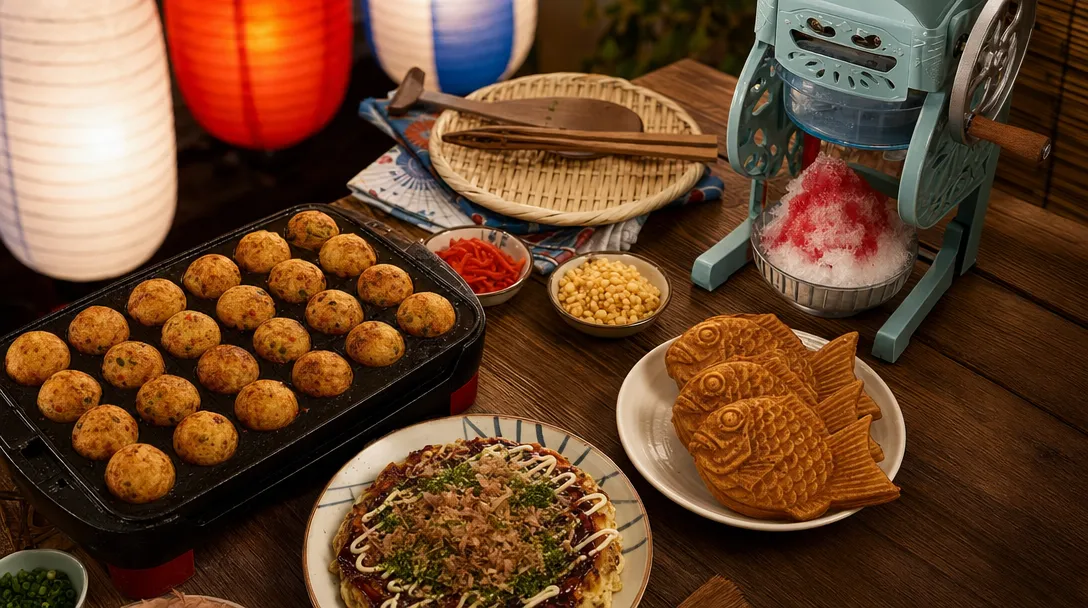 Related guidesTakoyaki maker, kakigori machine, taiyaki pan: Japanese festival food at home
The red 伝 mark: proof of a certified craft
A region name on a box tells you where something is said to come from, not that it is certified. For that, Japan uses the 伝統マーク (Densan mark): the character 伝 (“tradition”) combined with a red circle. Mie Prefecture explains that it is shown on products as proof that they are traditional crafts designated by the Minister of Economy, Trade and Industry.
To be designated, a craft has to meet five requirements, including being mainly for everyday use, being made mainly by hand at the steps that shape its character, using techniques with over 100 years of history, and using main materials in use for 100 years or more. As of 27 October 2025, when Tokyo hand-carved seals were added, there were 244 designated traditional crafts across Japan, according to the Kanto Bureau of Economy, Trade and Industry.
That “everyday use” rule is worth repeating to a friend: these are meant to be used at dinner, not kept in a glass case.
Microwave and dishwasher: what the official sources say
| Item | Microwave | Dishwasher |
|---|---|---|
| Wooden or bamboo chopsticks, wooden lacquer bowls | Not suitable: Saitama Prefecture lists wood and bamboo items | Follow the care line on the label |
| Porcelain with gold or silver decoration (common on gift sets) | Not suitable: Saitama Prefecture lists gold or silver decoration | Follow the maker’s label |
| Plain porcelain or stoneware, no metallic decoration | Not on the official “cannot” list; check the maker’s label | Follow the maker’s label |
| Stainless steel chopsticks or enamel | Not suitable: metal is on the list | Follow the maker’s label |
Saitama Prefecture’s kitchen safety leaflet lists stainless steel, enamel and other metal containers, dishes with gold or silver decoration, wood and bamboo items, and glass that is not heat-resistant among containers that cannot go in a microwave.
On dishwashers, we did not find an official statement from a lacquer craft association, so we do not give a blanket rule. Japanese labels must include care instructions, so read them. If you need everything to go in the dishwasher, pick a pair that is labelled dishwasher-safe and buy it for that reason.
Who should skip lacquered chopsticks
- If everything you own goes in the dishwasher. Unless the label says dishwasher-safe, a lacquered pair may not fit your routine; check the care line first.
- If you need proof of origin for a gift and the listing shows no label. Choose a seller who shows the label or the Densan mark, or buy in Japan.
- If you were searching “Japanese chopsticks for hair”. That is a different thing: hair sticks, a hair accessory.
Buying in the US, or in Japan
In Japan, you can read the label in the shop, and in Obama you can watch the craft being made. Chopsticks are light, so they fit easily in a suitcase.
From the US, you can search Amazon.com for lacquered chopsticks, chopstick rests (hashioki) and Mino ware bowls, or eBay for sellers shipping from Japan. Japan’s label rule does not cover these listings, so read each one for the coating and base material, and do not rely on “Wakasa” in a product name alone. Hyozaemon, a maker that started as lacquer craftsmen in Obama, says on its site that it was founded in 1921 (Taisho 10) and uses natural urushi with no synthetic paint for the tips that go into your mouth. That is the kind of detail worth looking for in any listing.
Import charges: US Customs and Border Protection has suspended duty-free de minimis entry for goods worth $800 or less from all countries, including mail, so a parcel of bowls from Japan can owe duties. Check whether the shop charges them at checkout. For how this works with parcels from Japan, see Japanese souvenirs you can order online.
Once the bowl is on the table, what goes in it?
A rice bowl wants rice, and Japanese short-grain rice is usually cooked in a rice cooker. Which one does that best on a US outlet? Our Japanese rice cooker guide explains micom vs IH and what “5.5 cups” means. And when you take your new chopsticks to a sushi bar, is it hands or chopsticks? See sushi etiquette in Japan.