 Eastbound Finds
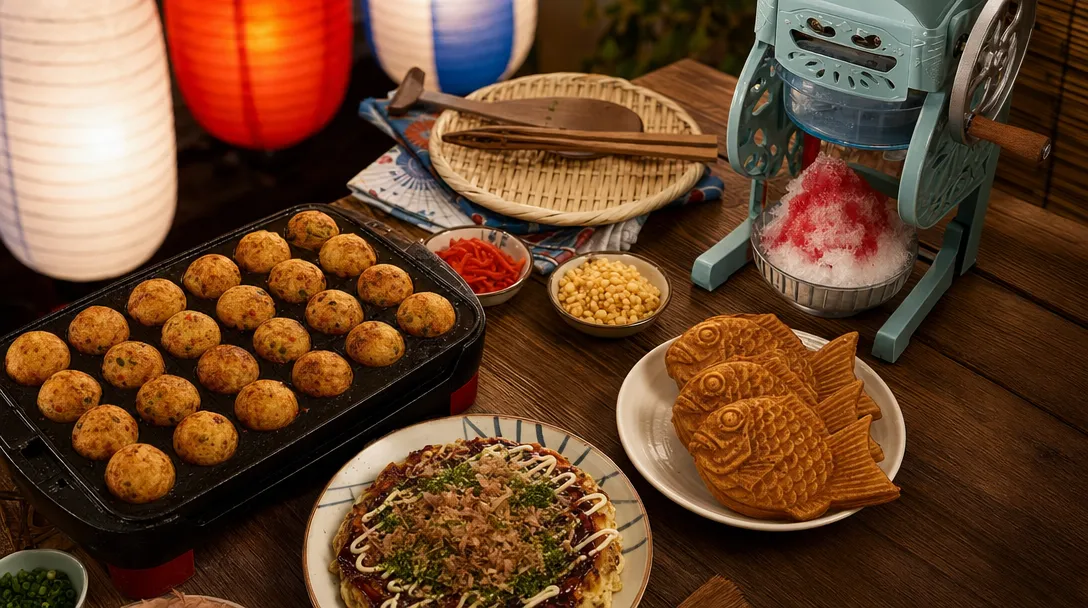
Hana here. Walk through any Japanese summer festival and the smell arrives before the stalls do: takoyaki turning in their round moulds, okonomiyaki on a griddle, a block of ice being shaved into a snowdrift of kakigori. This guide shows which takoyaki maker, shaved ice machine and taiyaki pan you can actually use at home, what the official recipes say, and the one thing to check before you buy a machine in Japan: the voltage.
Key points
- To make takoyaki at home you need a pan with round holes: an electric maker, a cast iron pan for the stove, or a cassette gas maker.
- Japan runs on 100V, and Zojirushi, Yamazen and Doshisha say their Japanese models are for use in Japan only, so buy a model made for your country's voltage.
- Zojirushi America sells a 120V griddle, the EA-BDC10, with an optional takoyaki plate that makes up to 26 large balls.
Show more
- Otafuku's official takoyaki recipe makes about 32 balls from 200 g flour, 3 eggs and 600 ml water or dashi, on a plate heated to about 200°C.
- Japanese okonomiyaki and takoyaki flours usually contain fish stock, so they are not vegetarian.
What makes festival food taste like a festival
Yatai (food stalls) line the approach to a shrine during a matsuri, and most of what they sell is cooked in front of you on a purpose-made plate. That is why these dishes are hard to fake in a normal frying pan:
AdvertisingQuick pick: Electric takoyaki makers for US outlets (120V) – Amazon.com
 Mikan's note: Japanese takoyaki makers and shaved ice machines run on 100V and many are labelled for use in Japan only, so check the voltage on the box before you buy one to take home.
- Takoyaki are balls of thin, dashi-flavoured batter with a piece of octopus inside, turned with a pick in a plate of half-round holes until the outside is crisp and the middle stays soft. The dish is usually said to come from Osaka in the 1930s.
- Kakigori is ice shaved so finely that it feels like fresh snow, then soaked in syrup. The texture comes from the blade, not from the syrup.
- Taiyaki are fish-shaped cakes filled with sweet red bean paste, baked in a hinged iron mould. The shape is the whole point, so you need the mould.
- Okonomiyaki is the exception: a flat cabbage pancake you can cook in any wide frying pan.
If you would rather taste them on the street first, our guide to Japan’s autumn festivals lists the big ones and their dates, and the festival calendar covers the rest of the year.
Takoyaki at home: three kinds of maker
| Type | Example (official specs) | Good for | Watch out for |
|---|---|---|---|
| Electric takoyaki maker | Zojirushi America EA-BDC10 griddle (120V, 1,300W) with the optional EA-YBC01 takoyaki plate: up to 26 large balls | A party at the table, even heat, easy for beginners | Japanese-market models are 100V (Yamazen YOH-200: AC100V, 700W, 20 balls) |
| Cast iron pan for the stove | Many sizes, from 12 to 20 or more holes | No voltage problem, lasts for years, crisp outside | Heavy, needs seasoning; check it suits your hob (gas, electric or induction) |
| Cassette gas maker | Iwatani En-Tako II CB-ETK-2: 40 mm holes, 1.74 kW, about 110 minutes per canister, made in Japan | Strong heat like a street stall, works outdoors | The gas canisters cannot be shipped or flown from Japan (see below) |
Hole size matters more than the number of holes. Otafuku, the Hiroshima sauce maker, writes its Kodawari set recipe for holes 45 mm across and 22 mm deep, and Zojirushi’s Japanese hot plate EA-KL30 makes 30 balls of 43 mm. Smaller holes, like the 40 mm ones on the Iwatani, give you more, smaller balls from the same batter.
 Related guidesJapanese Knives Explained: Santoku vs Gyuto, Steel Types and Care
Why a takoyaki maker from Japan is the wrong souvenir
Japan’s mains electricity is 100V everywhere, at 50Hz in the east and 60Hz in the west, according to the Japan National Tourism Organization. Most of North America is about 120V, and Europe, the Middle East and much of Asia are 220–240V.
The makers are clear about it:
- Zojirushi says its Japanese-market products are not covered by warranty abroad and asks people not to use them with a transformer either, because that can cause breakdowns.
- Yamazen marks the manual of its takoyaki maker “FOR USE IN JAPAN ONLY”.
- Doshisha, which makes Japan’s best-known home shaved ice machines, says in its FAQ that its machines can be used in Japan only, not overseas.
So if you live outside Japan, buy an electric maker made for your own voltage (the US-market Zojirushi above is one), or skip electricity altogether with a cast iron pan.
The cassette gas trap. A gas takoyaki maker such as the Iwatani is tempting because it has no voltage problem, but the fuel is. Japan Post says cassette stove gas cannot be sent by international mail by any route, even by sea, and New Chitose Airport lists it among items allowed in neither hand nor checked luggage. You would have to find canisters in your own country that fit the stove.
Otafuku’s official takoyaki recipe
From Otafuku’s Japanese recipe page (checked 19 October 2026), for 4 people and about 32 balls:
- Mix 200 g plain flour, 3 eggs, 20 ml milk and 600 ml water or dashi into a thin batter.
- Heat the plate to about 200°C, oil every hole well, and fill each hole about halfway.
- Drop in the octopus (about 160 g in total), then sprinkle 2 chopped spring onions and 30 g of tenkasu (tempura crumbs) over the whole plate.
- Top up with batter so it overflows, and when the edges set, turn each ball a quarter with a pick, tucking the overflow in. Keep turning until round and golden.
The batter is much thinner than pancake batter. That is not a mistake: it is what keeps the middle soft.
Kakigori: the blade is everything
The 2026 Hello Kitty edition of Doshisha’s electric Toroyuki machine (6,908 yen in Japan; the Toroyuki series has sold over 1.5 million units since 2016, Doshisha says) has a dial to raise or lower the blade, which is how you choose between coarse crunch and fluffy snow. It can shave flavoured ice frozen from juice or condensed milk, ordinary cubes from a home freezer, and frozen fruit.
One detail from Doshisha’s FAQ is worth knowing before you buy any kakigori machine:
- Home machines are designed for ice frozen in their own cups. Hard shop-bought block ice can damage the blade, and Doshisha allows it only on its hand-crank Kachiwari model.
A kakigori shaved ice machine with an adjustable blade is the thing to look for; a basic snow-cone machine crushes rather than shaves.
Taiyaki: buy the mould, not the machine
A taiyaki mould is a hinged pair of fish-shaped iron plates. Iwachu, a Japanese cast iron maker, sells one (model 24030) with a mould 12 × 6.5 cm inside, weighing about 1.6 kg, for gas and open flame, at 8,470 yen in Japan. Because it uses no electricity, a cast iron mould is one of the few festival tools that travels well. Fill it with batter, add a spoon of red bean paste (anko), cover with more batter, close and turn it over the flame.
Okonomiyaki flour: read the label
You do not need special equipment for okonomiyaki, but you may want the flour. Otafuku Okonomiyaki Flour lists kelp, mixed dried fish and bonito powders, and its allergen line shows wheat, mackerel and soy. Otafuku’s takoyaki flour also lists milk and yam. So:
- Neither is vegetarian. For a fish-free version, use plain flour with a vegetable stock.
- Neither is gluten-free.
- For halal diets, note that Otafuku’s halal certification (from Malaysia’s JAKIM, since March 2017) covers specific products made at its Malaysian factory, not everything with the Otafuku name. Look for the halal mark on the bottle you buy.
Sauce and mayonnaise finish both okonomiyaki and takoyaki. If you are stocking a Japanese pantry anyway, our Japanese curry roux guide uses the same approach of reading the official ingredient list before you buy.
Your next step
- Decide which dish you will make most. For takoyaki at a party, pick an electric maker for your voltage; for one dish that lasts for years, a cast iron pan.
- Do not carry a 100V machine or cassette gas home from Japan. Buy locally, or order a voltage-matched model online.
- Add a taiyaki pan shipped from Japan or a shaved ice machine when you want the second festival dish.
Voltage, maker specifications, recipes and shipping rules checked on official pages on 19 October 2026. Prices are Japanese list prices including tax. Check the voltage label and your country’s rules before you buy.