 Eastbound Finds
Hana here: the line everyone sings at Awa Odori is a joke on the audience. “Odoru aho ni miru aho, onaji aho nara odoranya son son” means “a fool who dances and a fool who watches – if you’re both fools, you might as well dance.” And at this festival you really can: in Tokushima, a free walk-in group lets visitors join the dancers on the street. Below are the 2027 dates, Tokushima vs Tokyo’s Koenji, seat prices and how to join (all checked on the official sites on 27 October 2026).
○ Language: OK with a translation app
The official festival site, ticket sales (Ticket Pia) and the niwaka-ren flyer are in Japanese only; the niwaka-ren needs no booking and includes a lesson by a well-known group. Koenji has an official English page. (Checked: )
Key points
- The chant "Odoru aho ni miru aho, onaji aho nara odoranya son son" means "a fool who dances and a fool who watches; if you're both fools, you might as well dance."
- Tokushima's Awa Odori runs from 11 to 15 August every year and draws more than a million visitors; the 2026 street shows ran 12–15 August from 6 pm to 10 pm.
- Tokyo's Koenji Awaodori is on the last weekend of August (29–30 August in 2026), with over 10,000 dancers on 8 routes around Koenji Station.
Show more
- In Tokushima, paid street seats cost ¥1,000–6,000 in 2026 (sold through Ticket Pia), and there are free viewing areas as well.
- Anyone can join the 'niwaka-ren' walk-in group in Tokushima for free with no booking: in 2026 there were sessions at 6:30 pm and 7:30 pm at the Shinmachibashi-higashi area, 12–15 August.
This official film from the Tokushima organisers gives you the whole festival in three minutes:
THE AWAODORI – official movie (Awa Odori Mirai e Tsunagu Executive Committee)
What the “fools” chant means, and why it fits
The full line goes “Odoru aho ni miru aho; onaji aho nara odoranya son son!” It comes from the festival song Awa Yoshikono, and the Japan Tourism Agency’s commentary renders it as “Dancing fools and watching fools! Everyone’s a fool, so why not dance?” Aho means “fool” and son means “a loss”: sitting it out is the bad deal.
AdvertisingQuick pick: Hotels in Tokyo (for Koenji Awaodori) – Trip.com
 Mikan's note: Going to Tokushima in mid-August? Book your room early – more than a million visitors come over five days. For Koenji, don't lay down a sheet to save a spot: the organisers ban it.
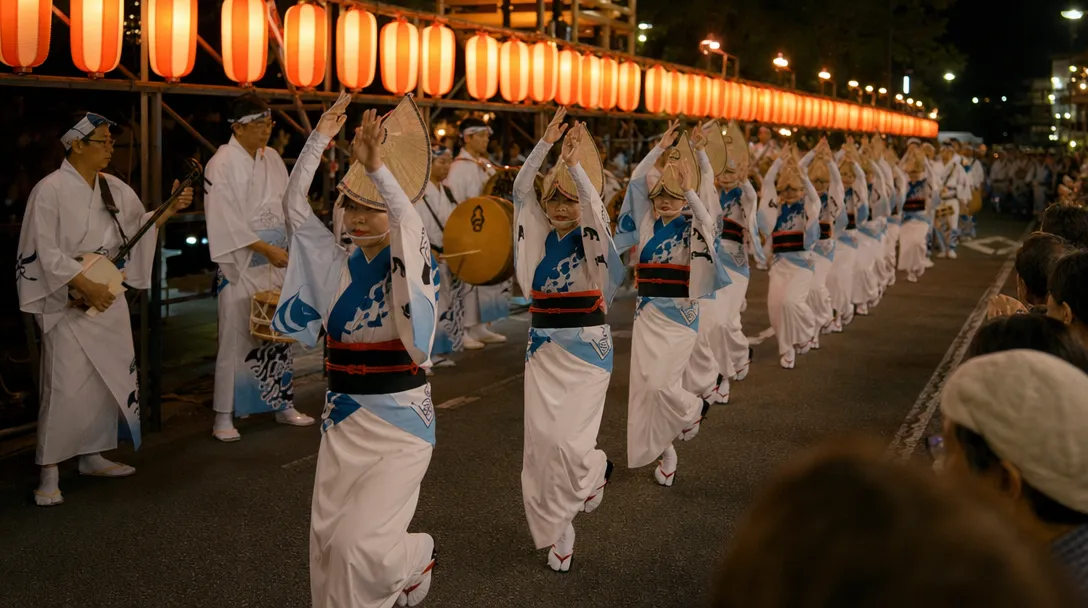
The chant is sung by the dance teams (ren; around 800 of them perform in Tokushima each year) as they move through the streets to shamisen, flute, drums and a hand-held gong.
Three things that surprise first-timers:
- The arms stay up. The Japan Tourism Agency’s commentary describes the women’s dance as balancing on the front of their wooden geta “with their hands held high in the air”.
- It walks in a straight line. Awa Odori grew out of Bon, the summer festival for welcoming back ancestors’ spirits. Bon dances usually go round in a circle; Awa Odori teams march down the street.
- The origin story involves a party. One story, told in the Japan Tourism Agency’s multilingual commentary, links it to the completion of Tokushima Castle in 1586, when the first lord, Hachisuka Iemasa, is said to have handed out free sake and encouraged people to dance. Tokushima City simply calls it a tradition said to be more than 400 years old.
The basic steps are the same for everyone, done in two styles: men dance low, with knees and feet pointing outwards; women move in tight formation in geta sandals with their heels off the ground, many wearing the half-moon amigasa straw hat.
Tokushima vs Koenji: which Awa Odori?
There are two big ones. Tokushima, on the island of Shikoku, is the original; Koenji in Tokyo started in 1957 to bring shoppers back to the local shopping streets.
| Tokushima (the original) | Koenji, Tokyo | |
|---|---|---|
| When | 11–15 August every year | Last Saturday and Sunday of August |
| 2026 | 11 Aug stage shows, 12–15 Aug street dancing | 29–30 Aug |
| 2027 (by the rule) | 11–15 August | 28–29 August |
| Size | More than 1 million visitors | Over 10,000 dancers, over 1 million spectators |
| Where | Several streets and stages in central Tokushima | 8 routes around JR Koenji and Shin-Koenji stations |
| Seats | Paid stands ¥1,000–6,000, plus free areas | Watch from the street |
| Join in | Free walk-in group (niwaka-ren) | Watch only; don’t enter the dance areas |
The short version: go to Tokushima if you want the full experience with a seat and the chance to dance; go to Koenji if you’re already in Tokyo at the end of August. Koenji’s official rules ask visitors not to put down plastic sheets to keep a spot, not to step into the dance areas, and to take their rubbish home.
A nice link between the two: on 14 August 2026, the Tokushima walk-in group was led by a joint team from the Koenji groups.
 Related guidesJapan Autumn Leaves Forecast 2026: Peak Dates for Kyoto, Tokyo and Nikko
Tokushima: dates, seats and prices
The Tokushima street shows run in the evening. In 2026 the paid stands had two sessions a night, 6:00–7:40 pm and 8:20–10:00 pm, with the audience changing in between. The three paid areas were Aibahama, Awagin Minami-uchimachi and Konyamachi.
| Seat (2026, advance, tax incl.) | Price |
|---|---|
| SS | ¥6,000 |
| S | ¥3,000 |
| A | ¥2,500 |
| B | ¥2,000 |
| C (unreserved) | ¥1,000 |
| Special seats at Minami-uchimachi | ¥15,000 |
Children aged 3 and over need a ticket. Tickets for the stands and the indoor shows are sold on Ticket Pia (Japanese site), linked from the official festival site. A seat is the easy way: you sit facing the street and every ren dances past you.
No ticket? There are free viewing areas too. In 2026 the Ryogoku-honmachi and Shinmachibashi areas ran 6:10–10:00 pm, and two “odori hiroba” squares ran 6:00–10:00 pm.
There are indoor shows as well, handy on a rainy day or in the afternoon: on 11 August 2026 “Takumi no Butai Suguribi” at Asty Tokushima (¥2,800–5,000), and 12–15 August “Yume no Butai Matsuribi” at Awagin Hall (¥2,800–4,500, shows at 11 am, 1:30 pm and 4 pm).
How to join the dance: the free niwaka-ren
This is the part most visitors don’t know about. A niwaka-ren is a “sudden” dance group made up of anyone who turns up. The 2026 official flyer from the Tokushima organisers set it out like this:
- Dates: every day, 12–15 August
- Where: Shinmachibashi-higashi dance area (the meeting point and the stage)
- Sessions: 6:30–7:30 pm and 7:30–8:30 pm. A well-known ren teaches the basic moves and the calls.
- The big moment: around 9:30 pm, everyone dances into the Shinmachibashi-higashi area together, led by a different guest group each night (in 2026 these included joint teams from Minami-Koshigaya, the Kansai Awa Odori association and Koenji).
- Cost: free, no booking. Just go to the area.
The lesson is given in Japanese, so one thing is worth knowing before you go: copy the people in front of you and keep your hands up high. Wear something you can move in.
Awa Odori Kaikan: watch (and try) it any day of the year
Missed August? The Awa Odori Kaikan hall in central Tokushima has shows every day. Checked on its official site on 27 October 2026:
| Show | Times | Length | Adult ticket |
|---|---|---|---|
| Day show | 11:00, 14:00, 15:00, 16:00 | 40 min | ¥1,300 (children ¥700) |
| Evening show by well-known ren | 20:00 | 50 min | ¥1,600 (children ¥800) |
Both shows include a corner where the audience can try dancing. The hall is closed on the second Wednesday of February, June, September and December (the next day if that’s a holiday) and from 28 December to 1 January. The ropeway up Mt Bizan starts from the same building.
Watch it at home first
The Tokushima organisers also stream the street dancing. Their recording of the 15 August 2026 evening runs about three hours – good for picking which seat or which night you want:
2026 Awa Odori – 15 August (Awa Odori Mirai e Tsunagu Executive Committee official)
August in Japan is full of these: what else is on the same week, and when is the next big festival after Awa Odori? Our calendar of Japan’s biggest festivals has them month by month, and the autumn festivals guide picks up from September. And if the food stalls are what you’ll miss most, can you make Japanese festival food at home?